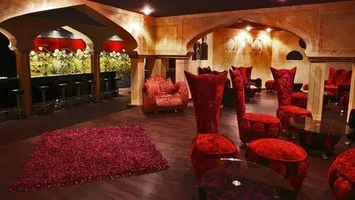
Rouge Zürich (CH)
Siewerdtstraße 69, 8050 Zürich
Last updated on
Something wrong or missing?
This club has closed for good.
Prices, opening times and all features · Rouge Zürich (CH)
Features
Yes · 12
- Air conditioning
- Beer included
- Draught beer
- Card payment / ATM
- Food included
- Adult cinema
- Valuables lockers
- Finnish sauna
- Soft drinks included
- Steam bath
- Hot dinner
- Indoor whirlpool
No · 18
- Outdoor area (garden)
- Cocktails
- Step-free access
- Free parking
- Free Wi-Fi
- Live DJ
- Live shows
- Professional massage
- Pick-up service
- Overnight stay possible
- Screened parking
- Slot machines
- SM room
- Live sport on TV
- Indoor pool
- Outdoor pool
- Solarium
- Outdoor whirlpool
More features
Size / area
Medium-sized club
- Indoor
- 1500 m²
What to expect at Rouge Zürich (CH)
Zürich
Zürich
Main town of the canton of Zürich
Name origin: Tūrīcon -> Turicum (Celtic --> Latin, = Turos, name designation)
First documented mention: known as a Roman customs station as early as 15 BC, 610 AD castellum Turegum; 7th century AD Ziurichi
Population: 415,000
Area: 91.88 km²
Canton: Zürich
District: Zürich
Circle: /
Vehicle registration: ZH
River: Sihl-->Limmat; Zürichsee-->Limmat
The Club Rouge is located in Zürich-Oerlikon.
Zürich lies in the geographical heart of Switzerland at 408 m above sea level, is by far its largest city and the economic centre in the land of the Confederates. As a leading metropolis, the city holds an important position as a continental transport hub and international financial centre, home to many major banks and the Swiss stock exchange. Zürich main station is the largest terminus station in Europe and one of the busiest train stations in the world; Zürich Airport is counted among the ten best airports in the world. Zürich's purchasing power level is outstanding by global comparison.
Zürich attained the status of a Free and Imperial City within the Holy Roman Empire in the 13th century. In 1351 the city joined the Swiss Confederacy and, together with Bern, was a leading city of this confederation of states. In 1519 Zürich became the epicentre of the Reformation under the spiritual leadership of Huldrych Zwingli, who shortly afterwards published the Zürich Bible here. With the collapse of the free republic of the city of Zürich following the French invasion of Switzerland in 1798, the city merged with the former subject territories into the new canton of Zürich and rapidly developed into the economic centre of Switzerland.
So why, despite all its economic dominance and its world-historical significance especially with regard to the Reformation, is Zürich not the capital of the land of the Confederates? The answer will surprise many non-Swiss. Switzerland, in fact, has no capital. In the Helvetic Republic (1798 – 1803), Switzerland's daughter republic of France during the Napoleonic era, Aarau, Lucerne and Bern were initially the capital. Since then, Switzerland has had no capital at all. From 1803 to 1848 the cities of Zürich, Bern, Lucerne, Fribourg, Solothurn and Basel took turns as so-called "Vororte der Schweiz" (leading cities of Switzerland). The annual Tagsatzung (Federal Diet) took place in these leading cities. In 1848 it was agreed to abolish the rotation principle. Zürich, Bern and Lucerne applied to become the capital. On 28 November 1848, the National Council and the Council of States decided in favour of Bern in the first round of voting. However, due to a thoroughly Swiss compromise, Bern officially did not become the capital, but rather the Bundesstadt (federal city). So Bern is the federal city and not de jure, but only de facto, the capital.
The city on Lake Zürich, with its Alpine backdrop, well-preserved medieval old town and a diverse range of culture and nightlife, is considered a city of outstanding quality of life. With its dozens of brothels, Zürich is at the same time also one of the "horniest" metropolises in the entire world, where those with a particular interest are guaranteed to be able to live out their inclinations in many different ways. As everywhere in Switzerland, this sector too stands out above all for the high quality of its services. So you should definitely bring a bit of money along on a visit.
Among Zürich's well-known sons and daughters are Johann Heinrich Pestalozzi, Gottfried Keller, Johanna Spyri, Conrad Ferdinand Meyer, Max Frisch, Hermann Rorschach, Felix Bloch, Mario Adorf, Lisa Fitz, Bruno Ganz, Martin Suter and Denise Biellmann.