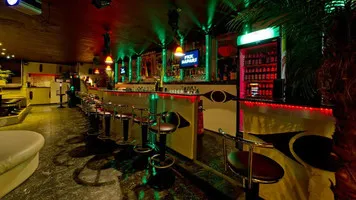
FKK Safari Pforzheim (D)
Wilhelm-Becker-Straße 9, 75179 Pforzheim
Last updated on
Something wrong or missing?
This club has closed for good.
Clubs nearby · FKK Safari Pforzheim (D)
Prices, opening times and all features · FKK Safari Pforzheim (D)
Features
Yes · 13
- Draught beer
- Cocktails
- Step-free access
- Free parking
- Professional massage
- Adult cinema
- Valuables lockers
- Finnish sauna
- Slot machines
- Soft drinks included
- Solarium
- Indoor whirlpool
- Outdoor whirlpool
No · 17
- Air conditioning
- Outdoor area (garden)
- Beer included
- Card payment / ATM
- Food included
- Free Wi-Fi
- Live DJ
- Live shows
- Pick-up service
- Overnight stay possible
- Screened parking
- SM room
- Live sport on TV
- Steam bath
- Indoor pool
- Outdoor pool
- Hot dinner
More features
Size / area
Small club
- Indoor
- 500 m²
- Outdoor
- 200 m²
What to expect at FKK Safari Pforzheim (D)
Pforzheim
- Name origin
- portus (Lat., = harbour)
- First documented mention
- 1067 AD
- Population
- 126,000
- Area
- 98 km²
- Federal state
- Baden-Württemberg
- Administrative region
- Karlsruhe
- District
- /
- Vehicle registration
- PF
- River
- Würm-->Nagold-->Enz
The club FKK Safari is located in Pforzheim to the west of the town centre in the commercial area "Wilferdinger Höhe" north of Maihalden.
Pforzheim lies about 30 km southeast of Karlsruhe at the confluence of the Enz, Nagold and Würm in the Gäu region of the Enz valley and the Kraichgau, and is also the northern gateway to the Black Forest. Pforzheim is regarded as the gold, jewellery and watch city par excellence in Germany. About 75 percent of German jewellery goods are produced in the city. Pforzheim is easily accessible via the A8 motorway and its IC railway station.
Pforzheim was originally settled by Celts; in Roman times a settlement was established at the ford where the Nagold flows into the Enz, and it was called "portus". This tradition of the name may be incomplete; little is known about the city until the Middle Ages. Emperor Heinrich IV visited the place several times and first mentioned it in a document from the year 1067. Around 1080 the settlement was granted market rights.
In 1220 the Margraves of Baden chose Pforzheim as their residence. About 300 years later the residence was moved to Durlach, which is why one speaks of the Baden-Durlach line. The city's affiliation with Baden, and later with the Duchy of Baden, remained; Pforzheim has stayed Baden to this very day. In 1618, at the beginning of the Thirty Years' War, Pforzheim had about 2,500 to 3,000 inhabitants and was thus by far the largest of the cities of the Margraves of Baden. In 1645, towards the end of the Thirty Years' War, Bavarian troops burned the Old Town down completely. It was rebuilt and flourished economically in particular through the timber trade and the traditional rafting trade, which had already been known at this location in Roman times. From the beginning of the 16th century, single logs and small rafts floated down from the Black Forest via the Enz, Nagold and Würm (the long, straight firs were ideal as building material) were bound together in the Pforzheimer Au into large rafts for the lower Enz, which becomes navigable from Pforzheim onwards, and for the waterway to the Neckar/Rhine. Tanning, cloth-making and textile manufacturing, alongside the trades, contributed to the city's wealth. During this period Pforzheim experienced the high points of its city history.
In 1718 the Pforzheim orphanage (Landeswaisenhaus) was opened in the building of the former Dominican convent. This orphan, lunatic, sick, penal and workhouse later became the nucleus of what is still today the jewellery and watch industry. Its founding took place in 1767 under Margrave Karl-Friedrich. With the support of an entrepreneur from Switzerland, a watch factory was set up in the orphanage to employ the orphaned children. Some time later the production of jewellery goods was added. The company developed rapidly, and soon it was exporting all over the world, although watch production soon disappeared and only experienced a renaissance from 1920 onwards with the manufacture of wristwatches. Around 1800 Pforzheim, with 900 factories, was regarded as Baden's first factory town and the most important centre of jewellery manufacturing in the world.
The lucrative business of rafting, on the other hand, was brought to an end in the 19th century by the construction of the Enztalbahn and Nagoldtalbahn railway lines in 1868 and 1874. New technologies were on the horizon. In 1836 Ferdinand Oechsle developed the must scale in the city, with which the must weight of freshly pressed grape juice is still measured today in degrees Oechsle. In the Year of the Three Emperors, 1888, Pforzheim was the destination of the first long-distance journey by automobile, which the Pforzheim-born Bertha Benz undertook without the knowledge of her husband Carl Benz, together with her two sons, setting out from Mannheim. Since 2008 the Bertha Benz Memorial Route has commemorated this pioneering feat.
Today the city has four large commercial areas: the Wilferdinger Höhe, the Brötzinger Tal, the Altgefäll and the Hohenäcker. The economy is now only partly oriented towards the production of watches and jewellery. Mail-order retail (Bader Versand, Versandhaus Klingel, Wenz) holds a leading position in Germany with its multi-million turnovers. A logistics centre of amazon.com is also based in Pforzheim.
The landmark of Pforzheim is the Schloss- und Stiftskirche St. Michael from the year 1219. It is the only larger remnant of the medieval cityscape of the town, which was destroyed in the Second World War. Worth seeing in the city, particularly with regard to its significance as a gold, jewellery and watch town, are the Schmuckmuseum Pforzheim in the Reuchlinhaus, the Technisches Museum der Pforzheimer Schmuck- und Uhrenindustrie, the Edelsteinausstellung Schütt and the Schmuckwelten Pforzheim shopping and experience centre.
The Bertha Benz Memorial Route between Mannheim and Pforzheim, which passes numerous sights, begins and ends in Pforzheim.
Among Pforzheim's well-known sons and daughters are Christopher Bechtler, Johannes Reuchlin, Bertha Benz, Victor Mayer, Heinrich Otto Wieland, René Weller, Manfred Mohr, Uwe Hübner and Peter Bofinger.