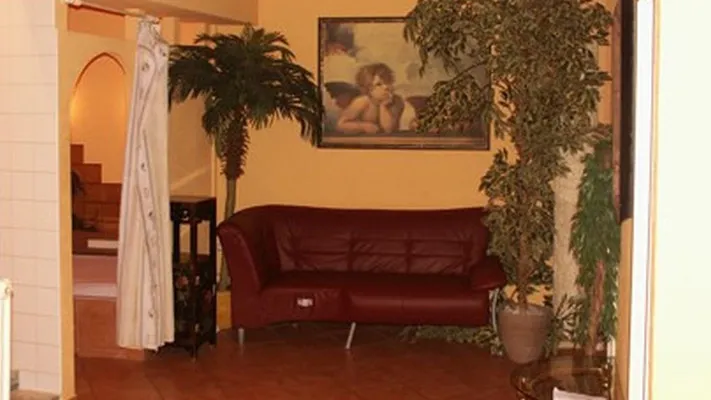
FKK Phönix Stuttgart (D)
Marienstraße 38b, 70178 Stuttgart
Last updated on
Something wrong or missing?
Prices, opening times and all features · FKK Phönix Stuttgart (D)
Features
Yes · 1
- Finnish sauna
No · 29
- Air conditioning
- Outdoor area (garden)
- Beer included
- Draught beer
- Card payment / ATM
- Cocktails
- Step-free access
- Food included
- Free parking
- Free Wi-Fi
- Live DJ
- Live shows
- Professional massage
- Pick-up service
- Adult cinema
- Overnight stay possible
- Valuables lockers
- Screened parking
- Slot machines
- SM room
- Soft drinks included
- Live sport on TV
- Steam bath
- Indoor pool
- Outdoor pool
- Solarium
- Hot dinner
- Indoor whirlpool
- Outdoor whirlpool
More features
Small club in Stuttgart city centre (Marienstraße); the entry is a contribution to costs and covers the whole day.
Size / area
Small club
- Indoor
- 500 m²
What to expect at FKK Phönix Stuttgart (D)
Stuttgart
Stuttgart
State capital of the federal state of Baden-Württemberg
Name origin: Stuotengarten (Old High German, = horse garden, stud farm)
First documented mention: approx. 948 AD
Population: 631,000
Area: 207.32 km²
Administrative region: Stuttgart
District: /
Vehicle registration: S
River: Neckar
The Club FKK Phönix is located in Stuttgart-Mitte.
The Stuttgarter drives a Mercedes, votes CDU and is very thrifty, or so they say. Ever since the Greens came to power in the land of the Swabians at the latest, we've known that this can't quite be true. For a Mercedes or even a Porsche from the local car manufacturers, there's usually enough cash to spare in the state capital of one of the wealthiest regions in Europe. "Stuttgart is sexy and still has the cash," countered Harald Schmidt, born in Neu-Ulm, in response to former Berlin mayor Klaus Wowereit's statement that Berlin is poor but sexy.
The lively metropolis on the Neckar may not be quite as big as Berlin and the other three German cities with over a million inhabitants, but it can certainly compete with them in terms of quality of life. Stuttgart looks back on centuries of proud and rich tradition, boasts magnificent cultural assets, is lined with wonderful landscapes and offers a modern and efficient infrastructure.
Stuttgart 21: The transport and urban development project to reorganise the so-called Stuttgart railway junction is one of the most ambitious construction projects in the history of the Federal Republic. Although the project is considered a billion-euro money pit and has sparked numerous protests among the local population, it could ultimately result in a groundbreaking, high-performance and hyper-modern urban infrastructure and transport concept that serves as a model for all of Europe.
The tension between tradition and modernity that the city has to bridge becomes clear when you take a few steps from the train station along Königstraße, Stuttgart's dominant promenade, and suddenly find yourself standing in front of the Schlosspark: the city's central gathering place is a successful ensemble of various buildings and green spaces from different eras, at the centre of which the Jubiläumssäule, the Opera House, the Altes Schloss and the Neues Schloss provide impressive testimony to the former baroque splendour of the Württemberg rulers in particular.
Just a few steps away, through the galleries of the Königsbau-Passagen, on Börsenstraße, you find yourself back in the high-tech modern world: the Stuttgart Stock Exchange is Germany's second most important trading venue after Frankfurt. If, on the other hand, you stroll straight down Königstraße to the south, past the Altes Schauspielhaus and the Gerber-Passagen, you'll not only reach FKK Phönix, Stuttgart's centrally located FKK club, but you'll also find yourself standing in front of the Karlshöhe, the walkable city hill in the heart of the city, the sight of which transports you to Athens with its Lycabettus and Acropolis.
Stuttgart is rich in theatres and museums, and given that it is the world's most renowned centre for automotive technology, it's no surprise that it has its own Mercedes Museum as well as a Porsche Museum. If, on the other hand, you venture beyond the hills of the roaring valley basin in which Stuttgart is nestled, you'll find a breathtaking view to the south in the panorama café of the 217 m high television tower, the city's modern landmark, situated at an altitude of 483 m above sea level. From up here, the view extends not only to Cannstatter Wasen on the Neckar, where the Stuttgart Oktoberfest, a rival to Munich's Wiesn, is held every year, but also, on a clear day, to the mountain ranges of the Swabian Alps, and you can catch sight of many of the pretty little towns nearby, each of which, embedded in a magnificent cultural landscape, bears eloquent testimony to charming Swabian tradition and way of life.
Stuttgart's well-known sons and daughters include Georg Wilhelm Friedrich Hegel, Karl Friedrich Alexander von Württemberg, Wilhelm Hauff, Gustav Schwab, Feodora zu Hohenlohe-Langenburg, Max Horkheimer, Fritz Bauer, Richard von Weizsäcker, Joachim Fuchsberger, Wolfgang Dauner, Eberhard Weber, Michael Pfleghar, Fritz Umgelter, Roland Emmerich, Gloria von Thurn und Taxis, Hansi Müller, Jürgen Klopp, Sami Khedira, Michael Beck, Natalia Wörner and Nina Hoss.