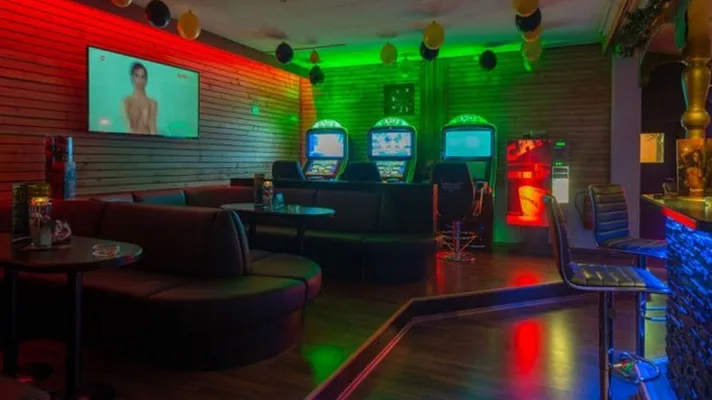
FKK Monaco Villingen-Schwenningen (D)
Gottlieb-Daimler Strasse 5, 78048 Villingen Schwenningen
Last updated on
Something wrong or missing?
This club has closed for good.
Club Monaco is closed for a complete renovation. According to its own website, it plans to reopen on 31 October 2026.
Clubs nearby · FKK Monaco Villingen-Schwenningen (D)
Prices, opening times and all features · FKK Monaco Villingen-Schwenningen (D)
Features
Yes · 13
- Outdoor area (garden)
- Draught beer
- Card payment / ATM
- Cocktails
- Free parking
- Professional massage
- Adult cinema
- Finnish sauna
- Slot machines
- Soft drinks included
- Outdoor pool
- Solarium
- Indoor whirlpool
No · 17
- Air conditioning
- Beer included
- Step-free access
- Food included
- Free Wi-Fi
- Live DJ
- Live shows
- Pick-up service
- Overnight stay possible
- Valuables lockers
- Screened parking
- SM room
- Live sport on TV
- Steam bath
- Indoor pool
- Hot dinner
- Outdoor whirlpool
More features
Size / area
Small club
- Indoor
- 400 m²
- Outdoor
- 200 m²
What to expect at FKK Monaco Villingen-Schwenningen (D)
Villingen Schwenningen
- Name origin Villingen
- ad Filingas (lat., = with the people of Filo, Vilmar)
- Name origin Schwenningen
- Suaninga (germ., = with the people of Swano, Swanagèr) --> Swenlingen
- First documented mention
- 817 AD
- Population
- 86,000
- Area
- 165,53 km²
- Federal state
- Baden-Württemberg
- Administrative region
- Freiburg
- District
- Schwarzwald-Baar-Kreis
- Vehicle registration
- VS
- River
- Brigach (Villingen), Neckar (Schwenningen)
The Club Monaco is located in Villingen.
The sentence "Villingen-Schwenningen is a dump in the Black Forest where you wouldn't want to hang dead over a picket fence" is wrong, and for the following reasons: firstly, Villingen-Schwenningen is a twin city, made up of Villingen in Baden and Schwenningen in Württemberg. Secondly, Villingen-Schwenningen isn't located in the forest at all, but on a high plateau at 758 m above sea level between the Black Forest and the Swabian Alb, right along the European watershed. Thirdly, these are two towns that can look back on a long history, which shows in each having its own pretty, central promenade and even its own train station. Fourthly, at the home of the Baden-Württemberg Police Academy, you shouldn't be hanging around picket fences, dead or alive. And fifthly, four different sauna clubs plus two eros centres in Villingen-Schwenningen currently keep those seeking entertainment well amused.
Anyone travelling from Baden-Baden or Offenburg to Villingen on the Schwarzwaldbahn will, after an almost adventurous ride through numerous tunnels and gorges, be quite astonished to discover that the city lies on a wide high plain, the so-called Hochmulde der Baar. Villingen-Schwenningen sits at 758 m above sea level, making it the highest-situated of all German cities with over 50,000 inhabitants. The town centres of Villingen and Schwenningen are about eight kilometres apart and connected by a country road. Local public transport between the two towns runs mainly via local buses, though there is also a direct rail connection via the southern loop of the regional track network. While Villingen sits right at the eastern edge of the Black Forest massif, from Schwenningen, further east, you already look out onto the ridges of the Swabian Alb. Very close by, in Donaueschingen, lies the source of the Danube, while near Schwenningen, in the Schwenninger Moos, lies the source of the Neckar. The recreational value of the city is obvious, given that the two towns have two wonderful natural landscapes right on their doorstep, and a further natural paradise, Lake Constance, lies just around forty kilometres further south. One small downside: Villingen-Schwenningen is considered the municipality with the highest hail risk in Germany.
The two towns merged into a twin city in 1972 and each have a different history. Both are first mentioned in 817 in a document of Louis the Pious, but while Villingen was assigned to the House of Fürstenberg in 1283 and belonged to Austria from 1326 to 1805, Schwenningen was assigned to the Oberamt Tuttlingen in 1444, from which it was transferred to the Oberamt Rottweil in 1842. Villingen still has a largely intact medieval town centre with several sights such as the early Gothic minster, the late Gothic town hall, and remnants of the town fortifications like the Bickentor, the Riettor, or the Pulvertürmle. Schwenningen was attacked by Villingen during the Peasants' War in 1525 and almost completely burned down, while Villingen itself had already been completely destroyed by a great fire in 1271.
Today, companies based in Villingen include Kienzle Apparate GmbH, which now belongs to Continental AG, as well as the music label HGBS. Villingen was also once home to the popular radio manufacturer SABA. In Schwenningen, a clock factory was founded by Johannes Bürk in 1858, and the town subsequently developed into a leading centre of clock manufacturing. Today the clock and time-recording companies Bürk, Eugen Trost, Kienzle, Mauthe, and ISGUS are based in the city. As a centre of Black Forest clock production, the town lies along the route of the Deutsche Uhrenstraße.
The singer Michelle, the ski jumper Martin Schmitt, and the two footballers Florian and Sebastian Rudy all come from Villingen-Schwenningen.