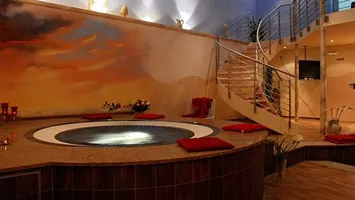
Monik Kempten (D)
Duracher Straße 3, 87437 Kempten
Last updated on
Something wrong or missing?
This club has closed for good.
Prices, opening times and all features · Monik Kempten (D)
Features
Yes · 8
- Outdoor area (garden)
- Draught beer
- Cocktails
- Finnish sauna
- Screened parking
- Slot machines
- Soft drinks included
- Indoor whirlpool
No · 22
- Air conditioning
- Beer included
- Card payment / ATM
- Step-free access
- Food included
- Free parking
- Free Wi-Fi
- Live DJ
- Live shows
- Professional massage
- Pick-up service
- Adult cinema
- Overnight stay possible
- Valuables lockers
- SM room
- Live sport on TV
- Steam bath
- Indoor pool
- Outdoor pool
- Solarium
- Hot dinner
- Outdoor whirlpool
Size / area
Small club
- Indoor
- 500 m²
- Outdoor
- 100 m²
What to expect at Monik Kempten (D)
Kempten
- Name origin
- Kambodounon (Celtic, = fortified place at the river bend), --> Cambidanum (name of a late Roman fort settlement)
- First documented mention
- 18 AD
- Population
- 69,000
- Area
- 63.28 km²
- Federal state
- Bavaria
- Administrative region
- Schwaben
- Vehicle registration
- KE
- River
- Iller
The Club Monik is located in Kempten-Sankt Mang/Ludwigshöhe.
In Kempten you find yourself at airy heights of 670 m above sea level and more: the Alps are within easy reach, Oberstdorf lies about 35 kilometres further south. After Villingen-Schwenningen, situated on the edge of the Black Forest, Kempten is the highest-lying of the larger German cities. Kempten lies in the Allgäu and carries this in its name to rule out confusion with the town of the same name near Bingen.
Kempten claims to be the oldest city in Germany. However, Trier makes the same claim, and who can rightfully lay claim to this title is not yet fully settled, especially since cities like Augsburg, Speyer, Worms, Bonn and Köln also have a word to say on the matter.
Kempten is a city that has developed since the early Middle Ages out of two towns existing side by side. On the one hand, the Kloster Kempten established itself here around the year 750, which according to legend was promoted from 773 onwards by Queen Hildegard, the wife of Karl der Große, and whose later Fürstabt developed a town on what was then the opposite bank of the Iller. On the other hand, Rudolf von Habsburg granted this very settlement a privilege in 1289; it was the first step on the path to emancipating itself from the guardianship of the monastic settlement and becoming a Free Imperial City.
By 1525 the time was ripe: Kempten acquired its complete independence from the Fürststift through the "Großer Kauf" for 30.000 Gulden and subsequently turned towards the Reformation. During the Dreißigjähriger Krieg, the Catholic Fürstabtei and the Protestant Reichsstadt stood opposed to each other as enemies. The monastery was destroyed by the Swedes in 1632; Fürstabt Roman Giel von Gielsberg had it rebuilt as a princely-abbatial residence between 1651-1674.
With the arrival of Electoral Bavarian troops in 1802, a line was drawn under the rivalries between the two towns that had dragged on for centuries: the traditionally Swabian Kempten became Bavarian. With the Bavarians came the roughly 200-year tradition of Kempten as a garrison town; it only really ended in 2015 with the closure of the artillery barracks.
The age of industrialisation was announcing itself: in 1852 the first railway station in Kempten was opened, and the city developed from a traditional region of flax cultivation into a centre for cotton spinning and weaving; the city also increasingly lived off tourism. Today Kempten is above all a location for the textile and timber industries and the dairy trade.
Due to the historical development described, there is much to see in Kempten, among other things the Burghalde with the Allgäuer Burgenmuseum and the open-air stage, the historic Rathaus, the Fürstäbtliche Residenz with Hofgarten and Orangerie, the Stadtpfarrkirche and the König-Ludwig-Brücke.
Kempten hosts culturally significant events known well beyond the region, such as the Allgäuer Festwoche, the Kemptener Jazz Frühling, the Musiknacht, as well as the APC-Sommer in the covered thermal baths of the Archäologischer Park Cambodunum. Independent of this, Kempten, thanks to its geographical proximity to the Bodensee and the Alpine region, is a city with a consistently high leisure value.