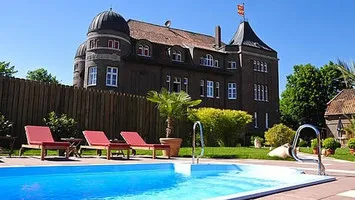
FKK Villa Hannover (D)
Am Tönniesberg 1, 30453 Hannover
Last updated on
Something wrong or missing?
This club has closed for good.
Prices, opening times and all features · FKK Villa Hannover (D)
Features
Yes · 18
- Air conditioning
- Outdoor area (garden)
- Draught beer
- Card payment / ATM
- Food included
- Free parking
- Professional massage
- Adult cinema
- Finnish sauna
- Screened parking
- Slot machines
- SM room
- Soft drinks included
- Live sport on TV
- Outdoor pool
- Solarium
- Hot dinner
- Indoor whirlpool
No · 12
- Beer included
- Cocktails
- Step-free access
- Free Wi-Fi
- Live DJ
- Live shows
- Pick-up service
- Overnight stay possible
- Valuables lockers
- Steam bath
- Indoor pool
- Outdoor whirlpool
More features
Size / area
Medium-sized club
- Indoor
- 1000 m²
- Outdoor
- 600 m²
What to expect at FKK Villa Hannover (D)
Hannover
Hannover
Capital city of the federal state of Lower Saxony
Name origin: Honovere (Middle Low German, = high bank)
First documented mention: 1150 AD
Population: 537,000
Area: 204.14 km²
District: Hannover
Vehicle registration: H
River: Leine
The Club FKK Villa is located in Hannover-Ricklingen.
From 1636 Hannover was the residence city of the House of Welf, and in 1692 it became the 9th Electorate of the Holy Roman Empire (Electorate of Brunswick-Lüneburg), out of which the Kingdom of Hannover emerged at the Congress of Vienna in 1814. Between 1714 and 1837 there was a personal union between Great Britain and Hannover, during which the Elector of Brunswick-Lüneburg, respectively King of Hannover, was simultaneously King of Great Britain. After the lost German War of 1866, the city on the Leine became a Prussian provincial capital, until in 1946 it was given the status of state capital in the newly founded federal state of Lower Saxony.
The historic old town was unfortunately largely destroyed during World War II; existing historic buildings in the centre are in particular the Marktkirche, the Old Town Hall, the Beginenturm and the Ballhof. Of classicist character are the Leineschloss, today seat of the Lower Saxon State Parliament, the Opera House, the Waterloo Column, the Wangenheimpalais and the Laveshaus. On the north side of the Maschpark lies the New Town Hall (1901-1913), the town hall of the Lower Saxon state capital, considered a magnificent building of so-called eclecticist architecture.
With the Maschsee, laid out between 1934-36, the Eilenriede city forest and the Herrenhausen Gardens, which include the Großer Garten, one of the most significant baroque gardens in Europe, the city boasts attractive leisure and green spaces. With its ultra-modern main station integrated into the city centre mile, dozens of museums and galleries, theatres, cinemas, music venues for all genres as well as discotheques, clubs, restaurants, the Spielbank Hannover, and not least the red-light mile at the Steintor, Hannover offers a wide range of excursion destinations and entertainment venues in a compact space.
Hannover's economic significance is expressed in its function as a trade fair city with the largest exhibition grounds in the world, where among others the leading world trade fairs CeBIT, Agritechnica and IAA Hannover take place. Furthermore, the city is home to numerous prominent companies, the most significant of which is the DAX-listed Continental AG.
Among the well-known sons and daughters of Hannover are Luise von Preußen, Friedrich & August Wilhelm Schlegel, Emil Berliner, Frank Wedekind, Hermann Bahlsen, Gustav Fröhlich, Grethe Weiser, Theo Lingen, Dieter Borsche, Hannah Arendt, Elly Beinhorn, Ernst August von Hannover, Rudolf Augstein, Mareike & Mathieu Carrière, Doris Dörrie, Hans Blum, Otto Sander, Klaus Meine, Matthias Jabs, Kai Wiesinger, Oliver Pocher, Maria Schrader, Per Mertesacker and Lena Meyer-Landrut.