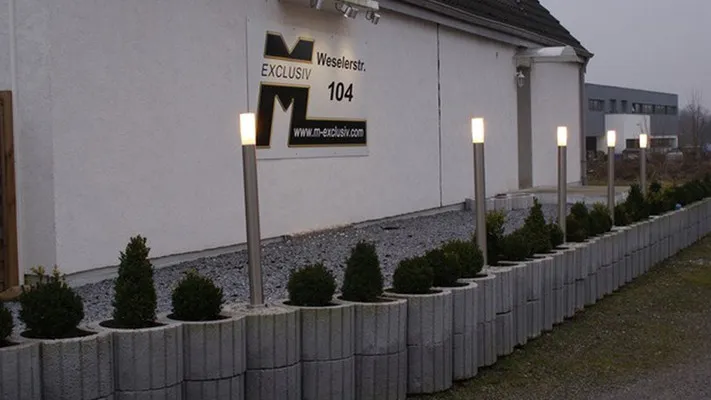
M-Exclusiv Dülmen-Buldern (D)
Weseler Straße 104, 48249 Dülmen-Buldern
Last updated on
Something wrong or missing?
This club carries on under a new name.
Carries on as: M-Exclusiv Selm (D)
Clubs nearby · M-Exclusiv Dülmen-Buldern (D)
Prices, opening times and all features · M-Exclusiv Dülmen-Buldern (D)
Features
Yes · 9
- Outdoor area (garden)
- Draught beer
- Card payment / ATM
- Free parking
- Valuables lockers
- Finnish sauna
- Screened parking
- Soft drinks included
- Live sport on TV
No · 21
- Air conditioning
- Beer included
- Cocktails
- Step-free access
- Food included
- Free Wi-Fi
- Live DJ
- Live shows
- Professional massage
- Pick-up service
- Adult cinema
- Overnight stay possible
- Slot machines
- SM room
- Steam bath
- Indoor pool
- Outdoor pool
- Solarium
- Hot dinner
- Indoor whirlpool
- Outdoor whirlpool
More features
Size / area
Small club
- Indoor
- 300 m²
- Outdoor
- 200 m²
What to expect at M-Exclusiv Dülmen-Buldern (D)
Dülmen-Buldern
- Name origin
- Dulmenni (designation of a "Bauerschaft", i.e. a settlement of scattered farmsteads)
- First documented mention
- 889 AD
- Population
- 47,000
- Area
- 184.83 km²
- Federal state
- Nordrhein-Westfalen
- Administrative region
- Münster
- District
- Coesfeld
- Vehicle registration
- COE, LH
- River
- Booksbach
The club M-Exclusiv is located in Dülmen-Buldern.
Dülmen is a small town in the Münsterland region. It is the largest town in the Coesfeld district. Dülmen consists of the districts Rorup, Buldern, Hiddingsel, Hausdülmen and Merfeld as well as the two urban districts Mitte and Kirchspiel. Dülmen is easily accessible via the A 43 motorway. The town has its own main railway station, where two historically grown railway lines cross; as a result, the exotic form of a tower station developed at this spot. The district of Buldern has its own railway station. Furthermore, the federal waterway Dortmund-Ems-Kanal runs through Dülmen's territory.
Dülmen developed around 800 from a Germanic settlement of individual and multiple farmsteads. In 1311 it was granted town rights by the Prince-Bishop of Münster, Ludwig II. The Prince-Bishopric of Münster held jurisdiction over Dülmen until 1803; after the withdrawal of Napoleonic troops, the town came under Prussian rule in 1816 and thus to Coesfeld.
From medieval times, the Lüdinghauser Tor, the Lorenkenturm and the Nonnenturm remain as part of the old town fortifications. The Lüdinghauser Tor is Dülmen's landmark and is located in the town centre. The oldest sacred building in Dülmen, and at the same time one of the oldest churches in the Diocese of Münster, is the catholic St.-Viktor-Kirche in the town centre. The church was already founded in 780; in its present form it has existed since around 1500, although it had to be reconstructed after the destruction of the Second World War.
Haus Osthoff is the oldest house in Dülmen. It is the only surviving building of the former manor Rittergut Osthoff and was built around 1727. The open spaces around the building are arranged in the style of a baroque, strictly formal garden; the house is a listed building.
Dülmen lies centrally in the scenically charming Münsterland region and is regarded as a cycling paradise. In the Dülmen nature reserve at Merbruch, the Dülmener Wildpferde, a hardy pony breed, thrive. Every year in May, the one-year-old stallions are caught from the herd at the Wildbahngestüt Wildpferdbahn stud farm. Another natural paradise in Dülmen is the nearby Wildpark Dülmen. It was designed in 1864 by its owner Alfred von Croÿ and the English landscape architect Edward Milner, and is connected via the so-called Vorpark, created at the same time, to the former site of the castle destroyed in 1945, of which today only the stables and the Schlosspark remain.
Known among mystics is the nun Anna Katharina Emmerick (1774-1824), who worked in Dülmen and was beatified by Pope John Paul II in 2004. Her birthplace in Coesfeld is today a memorial site set up as a museum.