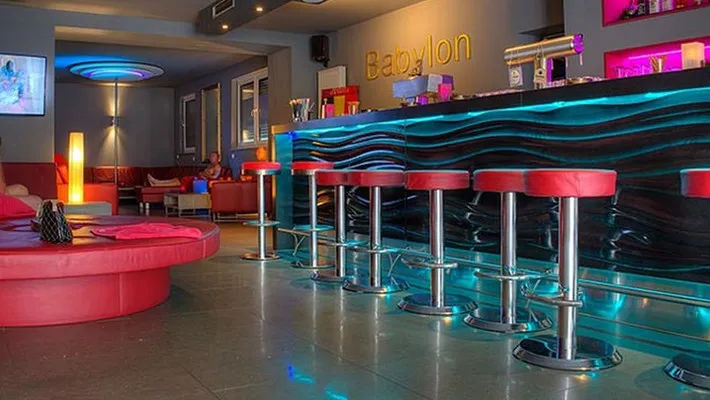
FKK Babylon Elsdorf/Köln (D)
Oststraße 12, 50189 Elsdorf
Last updated on
Something wrong or missing?
Prices, opening times and all features · FKK Babylon Elsdorf/Köln (D)
Features
Yes · 16
- Outdoor area (garden)
- Beer included
- Draught beer
- Food included
- Free parking
- Professional massage
- Adult cinema
- Finnish sauna
- Screened parking
- Slot machines
- Soft drinks included
- Live sport on TV
- Steam bath
- Outdoor pool
- Hot dinner
- Indoor whirlpool
No · 14
- Air conditioning
- Card payment / ATM
- Cocktails
- Step-free access
- Free Wi-Fi
- Live DJ
- Live shows
- Pick-up service
- Overnight stay possible
- Valuables lockers
- SM room
- Indoor pool
- Solarium
- Outdoor whirlpool
More features
Size / area
Medium-sized club
- Indoor
- 700 m²
- Outdoor
- 300 m²
What to expect at FKK Babylon Elsdorf/Köln (D)
Elsdorf
- Name origin
- Village of Agil; also possibly Egilhard, Eilhard (name of an abbot of Kornelimünster slain near Bergheim in the year 881) --> Egilo-, Egils- and Eilsdorf
- First documented mention
- 12th century AD
- Population
- 22,000
- Area
- 66.17 km²
- Federal state
- Nordrhein-Westfalen
- Administrative region
- Köln
- District
- Rhein-Erft-Kreis
- Vehicle registration
- BM
- River
- Erft (beyond the town boundaries)
The club FKK Babylon is located west of Köln in Elsdorf, on the eastern edge of the town centre.
Köln:
The history of NRW's largest metropolis, Köln, can be traced back to Roman times, from which various buildings such as the Römerturm, part of the city wall, have survived. The cathedral city is accessible via various motorways such as the A1, A3, A4 and A57. Rail travellers generally arrive in Köln at the Hauptbahnhof.
Long-distance rail travellers should note that not all ICE trains stop at Köln HBF; some, in order to save time, stop only at the station on the right bank of the Rhine, Köln-Messe/Deutz. For city traffic, Köln has a dense network of light rail and buses, supplemented by the S-Bahn. The light rail, operated with modern trams, connects the well-known cathedral city in NRW with, among others, Bonn.
The number of hotels and holiday flats in Köln is overwhelming. There are certainly also affordable places to stay, to be found not only in hostels close to the city centre but especially in guesthouses and hotels in Köln's outer districts.
The central sight is the cathedral, located directly at the Hauptbahnhof and by the Rhine, which is the city's landmark par excellence and one of the most significant Gothic buildings in the world. Köln also has numerous other churches and historic buildings, some of which even surpass the cathedral in their cultural-historical significance. Köln is also home to numerous art museums and the Römisch-Germanisches Museum. An insider tip is the chocolate museum, located right on the Rhine.
With Kölsch, Köln has its own special top-fermented beer, the enjoyment of which rounds off a visit to the city. On the Rhine promenade, right opposite the old town, there are wonderful restaurants and pubs with a view of the Rhine, where you can enjoy Köln's way of life late into the night. At the annual "Kölner Lichter" music and fireworks event held on the Rhine each summer, around a million spectators gather on both banks of the river.
Well-known sons and daughters of Köln include Jacques Offenbach, Ferdinand Franz Wallraf, Eduard Salomon von Oppenheim, Carl Bosch, August Bebel, Konrad Adenauer, Freya von Moltke, Wolfgang Graf Berghe von Trips, Mildred Scheel, Josef Neven DuMont, Willi Ostermann, Willy Birgel, Jupp Schmitz, Trude Herr, Willy Millowitsch, Peter & Mariele Millowitsch, Hans Süper, Otto Wolff von Amerongen, Nico, Heinrich Böll, Marie-Louise Steinbauer, Jürgen Becker, Rolf Kühn, Wolfgang Petry, Jürgen Zeltinger, Purple Schulz, Wolfgang Niedecken, Jean Pütz, Jack White, Dirk Bach, Heiner Lauterbach, Britta Heidemann, Anne Will, Marietta Slomka, Florian Henckel von Donnersmarck, Tina Ruland, Katharina Schüttler, Guido Cantz, Stefan Raab and Sarah Kern.
Facts about the super-metropolis of Köln on the Rhine:
- Köln looks back on around 2000 years of history and is thus one of the oldest cities in Germany
- alongside Prague and Nürnberg, Köln was the most important city of the Holy Roman Empire (962-1803)
- Köln Cathedral (Hohe Domkirche Sankt Petrus) is one of the most significant sacred buildings in the world, home to the largest church bell of all, and houses the relics of the Three Kings
- the Archdiocese of Köln is, after Munich and Paderborn, the third-richest diocese in Germany
- Kölner Karneval is the largest carnival festival in the northern hemisphere and brings the city a turnover of around 400 million euros during the "fifth season"
- the WDR, based in Köln, is the largest broadcaster in Europe after the BBC
- RTL, based in Köln since 1988, is the largest private broadcaster in Europe
- with around 50,000 students, Köln is home to Germany's third-largest university, after Munich and the Fernuniversität Hagen
- the Schildergasse/Hohe Straße in Köln's city centre is one of Germany's busiest shopping streets
- the Kölner Pascha on Hornstraße is the largest high-rise brothel in the world
- Kölsch is, on the one hand, a pale, top-fermented full beer that, according to the Kölsch Convention, may only be produced in and around Köln...
- ...and on the other hand an urban dialect belonging to the Ripuarian dialects, which hardly anyone outside the Köln metropolitan area understands
- the Kölscher Klüngel is a globally unique system, based on mutual assistance and favours between officials in administration and business, for the benefit of the population
- the Kölsche Grundgesetz is the informal constitution of the city of Köln and contains 11 articles plus further supplementary articles:
Article 1: Et es wie et es.
Article 2: Et kütt wie et kütt.
Article 3: Et hätt noch emmer joot jejange.
Article 4: Wat fott es, es fott.
Article 5: Et bliev nix wie et wor.
Article 6: Kenne mer nit, bruche mer nit, fott domet.
Article 7: Wat wells de maache?
Article 8: Maach et joot, ävver nit zo off.
Article 9: Wat soll dä Kwatsch?
Article 10: Drinks de ejne met?
Article 11: Do laachs de disch kapott.
Important additional articles:
Jede Jeck is anders.
Küss de hück nit, küss de morje.
Et hätt noch schlimmer kumme künne.
Mer muss och jünne könne.
Mer muss sisch och jet jünne könne.
Bliev wie do bes.
Dä Herrjott es janit esu.
Hammer immer esu jemaat.
Nit alles, wat en Loch hät, is kapott.
Mät nix.
Wat däm ein sing Ül eß däm andere sing Naachtijall.
Mir sin nit aaberjläubisch.
Wer fean kan, de kan och maloche.
Mer weis et nie, mer stich nit drinn.
Dröm Jeck loß Jeck e lahnß.
Och dä raderdollste Aasch hät sing Visaasch.
Jedem Diersche sing Pläsiersche.
Dat jitt et nur, nur, nur in Kölle.
Dat sull ech jesaat hann?
Du bes Kölle.
Der wiess nix.
Haevemer nit koenemar nit.
Levve und levve losse.
Elsdorf:
Far out beyond the gates of Köln lies Elsdorf, a predominantly rural municipality in the Rhein-Erft-Kreis west of the cathedral city. The town is excellently connected to road traffic via the A61, and from Köln it is reachable in particular via the stations Sindorf, Horrem, Quadrath-Ichendorf and Zieverich, from which regional buses run to the Elsdorf bus station.
In its current territorial form, Elsdorf has existed since 1975 and comprises the communities of Angelsdorf, Elsdorf, Esch, Heppendorf, Niederembt and Oberembt. A large part of the town's area is taken up by the Hambach open-cast mine in the Rhenish lignite mining region, in the neighbourhood of the town of Jülich, to whose duchy Elsdorf belonged from medieval times until 1794. The Rhenish lignite mining region, consisting of the Jülicher Börde, Zülpicher Börde, Erft lowlands and Ville, is considered the largest lignite mining region in Europe. Accordingly, alongside the Pfeifer & Langen sugar factory, the biggest employer in Elsdorf is RWE Power AG.