LaLuna Moers (D)
Kautzstraße 9, 47441 Moers
Last updated on
Something wrong or missing?
Prices, opening times and all features · LaLuna Moers (D)
Features
Yes · 4
- Finnish sauna
- Slot machines
- Soft drinks included
- Steam bath
No · 26
- Air conditioning
- Outdoor area (garden)
- Beer included
- Draught beer
- Card payment / ATM
- Cocktails
- Step-free access
- Food included
- Free parking
- Free Wi-Fi
- Live DJ
- Live shows
- Professional massage
- Pick-up service
- Adult cinema
- Overnight stay possible
- Valuables lockers
- Screened parking
- SM room
- Live sport on TV
- Indoor pool
- Outdoor pool
- Solarium
- Hot dinner
- Indoor whirlpool
- Outdoor whirlpool
More features
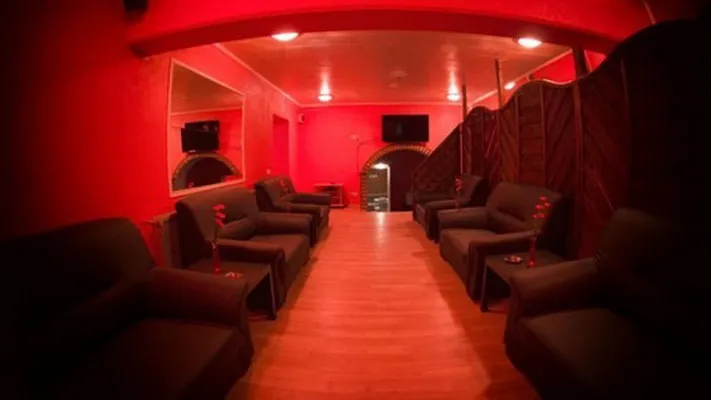
Small club near the city centre of Moers, at the end of Kautzstraße, entrance on the left down the stairs. New sauna with infusions and infrared, steam sauna, lounge bar, smoking area. Parking available.
Size / area
Small club
- Indoor
- 400 m²
What to expect at LaLuna Moers (D)
Moers
- Name origin
- murse (Old High German, = marsh/morass)
- First documented mention
- 9th century AD
- Population
- 104,000
- Area
- 67.68 km²
- Federal state
- Nordrhein-Westfalen
administrative district (Regierungsbezirk): Düsseldorf
district (Kreis): Wesel
Vehicle registration: WES, DIN, MO
River: Moersbach
The club LaLuna is located in Moers between the town centre and the train station.
The Rhine separates landscapes and regions. Moers borders directly on the left-bank districts of Duisburg and is only about 10 km from the bustling city centre of its big neighbour, yet it has largely preserved its tranquil character, so typical of the many towns of the Lower Rhine region between the Rhine and the Meuse. The town is perfectly connected to long-distance car traffic — especially to and from the Netherlands — via the A57 motorway to the west and the transversal A40 and A42, which form the Kreuz Moers and Kreuz Kamp-Lintfort interchanges here. Moers also has a special relationship with the Netherlands, since in 1597 Maurice of Orange captured the town. Under Dutch rule the town flourished economically and remained largely spared from the destruction of the Thirty Years' War. It was not until 1702 that Moers passed to Prussia through inheritance, and in 1706 it became a principality.
The former medieval county has, in its town centre, a cosy pedestrian mile, directly adjoined on the south side by the sprawling Schlosspark with the town's most famous building — the Moerser Schloss — whose first form was already built around 1200. Distances in Moers are short, and outside the town centre, particularly to the west and north, there are commercial areas that today shape part of the townscape.
Up until around 1800, Moers was shaped exclusively by agricultural activity and craftsmanship; with the onset of industrialisation, a flourishing textile industry initially developed here. At the beginning of the 20th century, however, Moers was entirely defined by mining. On the Rheinische Bergbauroute, part of the Route der Industriekultur, one can today find the Pattberg shaft complex, the Pattberg spoil tip, the Rheinpreußen 4 shaft complex, the Rheinpreußen 5/9 shaft complex, the Eurotec Technologiepark, the Rheinpreußen spoil tip, and the Zechenkolonie Meerbeck mining colony. Shaft IV of the Rheinpreußen mine was renovated after the plant's closure in 1990 and is today a mining museum; the Eurotec Technologiepark stands on the site of the former Rheinpreussen 5/9 mine. With the last colliery closing in 2001, Moers bid farewell to the mining era; today the townscape is shaped by a good mix of medium-sized businesses.
In the cultural field, Moers has gained worldwide recognition among music lovers through the Internationale New Jazz Festival Moers - now called "moers festival". The multi-day festival has taken place since 1972, mostly over the Whitsun holidays, and covers a wide spectrum of musical styles, ranging from free jazz and jazz rock to world music, soul, funk and hip-hop. Until 2014, the usual venue was the town's Schlosspark; since then the festival has taken place over four days in the new festival hall at the Solimare site, holding 2,000 visitors, run by the leisure operator ENNI, which operates open-air pools and sports facilities in and around Moers.