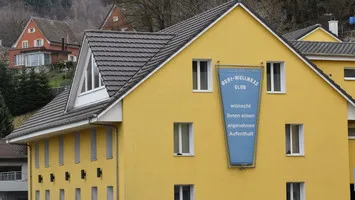
FKK Gebi Gebenstorf/Brugg (CH)
Landstraße 75, 5412 Gebenstorf
Last updated on
Something wrong or missing?
This club has closed for good.
Clubs nearby · FKK Gebi Gebenstorf/Brugg (CH)
Prices, opening times and all features · FKK Gebi Gebenstorf/Brugg (CH)
Features
Yes · 12
- Outdoor area (garden)
- Draught beer
- Card payment / ATM
- Free parking
- Finnish sauna
- Screened parking
- Soft drinks included
- Live sport on TV
- Indoor pool
- Solarium
- Hot dinner
- Indoor whirlpool
No · 18
- Air conditioning
- Beer included
- Cocktails
- Step-free access
- Food included
- Free Wi-Fi
- Live DJ
- Live shows
- Professional massage
- Pick-up service
- Adult cinema
- Overnight stay possible
- Valuables lockers
- Slot machines
- SM room
- Steam bath
- Outdoor pool
- Outdoor whirlpool
More features
Size / area
Small club
- Indoor
- 750 m²
- Outdoor
- 50 m²
What to expect at FKK Gebi Gebenstorf/Brugg (CH)
Gebenstorf
- Name origin
- (ze) brucco (Old High German, = at the bridge) --> Bruggo
- First documented mention
- 1064 AD
- Population
- 13,000
- Area
- 8.26 km²
- Canton
- Aargau
- District
- Brugg
- Vehicle registration
- AG
- River
- Reuss-->Aare, Limmat-->Aare
The Club FKK Gebi near Brugg is located in Gebenstorf.
Brugg:
Brugg is a small town in the Swiss canton of Aargau and the chief town of the Brugg district. It lies at 352 m above sea level, about 16 km northeast of Aarau, and is easily reached via the A3 motorway and Brugg railway station.
The area within the catchment of Brugg, Windisch, Gebenstorf, Turgi, Stilli and Untersiggenthal on the southern edge of the Jura is known as the Wasserschloss of Switzerland, because it is here that the three rivers coming from the Alps – the Aare, the Reuss and the Limmat – merge at the Gebenstorf district of Vogelsang.
Around 58 BC, the Helvetii founded the settlement of Vindonissa near Brugg on the hill spur between the Aare and the Reuss, on the territory of what is today the neighbouring municipality of Windisch. Around 15 BC the Romans built a military station here, which from 14 AD onward they expanded into a legionary camp. In the late 10th century a noble family, possibly descended from the Alsatian Etichonids, settled in Altenburg. Count Lanzelin had the Roman fort converted into the small castle of Altenburg, which today stands 1 km west of Brugg's town centre. Around 1020, the Habsburg castle was built 3 km to the southwest on the Wülpelsberg. The Habsburgs, named after this castle, lived here for only around two hundred years. As the increasingly powerful comital family grew, they left the castle around 1220/30, as it seemed too small and insufficiently prestigious. It was subsequently leased to various vassals. With the conquest of the Aargau in 1415 by the Confederates, the Habsburgs – who by then had established a far more significant seat of power in Vienna – lost their ancestral castle for good. Since 1804 the Habsburg castle has been owned by the canton of Aargau. The castle and fort area of the Altenburg, on the other hand, was bought in 1938 by the Pro Vindonissa society and the Aargau Historical Society; today it houses the town's youth hostel. The Altenburg is the earliest verifiable residence of the Habsburgs.
In 1284, Brugg was granted town rights. Even after the Habsburgs moved away, the town remained firmly in their hands until, on 29 April 1415, the Bernese Confederates marched in. Brugg kept its town rights, and after decades of disputes over Brugg, Bern finally took control in 1460. As French troops advanced ever further at the start of 1798 and the end of Bernese rule became foreseeable, a revolutionary committee seized power in Brugg. After French troops led by General Guillaume-Marie-Anne Brune marched into Bern on 5 March, delegates from the major cantons established the Helvetic Republic in Aarau on 12 April. At the beginning of the 19th century, Brugg turned into a stronghold of liberalism. However, in the age of industrialisation, the political will to attract industry was initially lacking. In 1858 Brugg was connected to the railway, and the region subsequently became a centre of the livestock trade. From 1920 onward, industry accounted for roughly half of all jobs. Today, around 700 small and medium-sized enterprises, particularly from the service sector, are based in Brugg. Brugg is the seat of the Swiss Farmers' Union and the centre of the Swiss Genie troops.
In Brugg's old town and its surroundings, many testimonies to the town's eventful history can still be found, such as the Schwarzer Turm, the Reformed town church, the Rotes Haus, the Latin school, the Palais Fröhlich and the Zeughaus. The Industriekulturpfad Limmat–Wasserschloss, which passes 44 industrial-historical monuments, ends in Brugg.