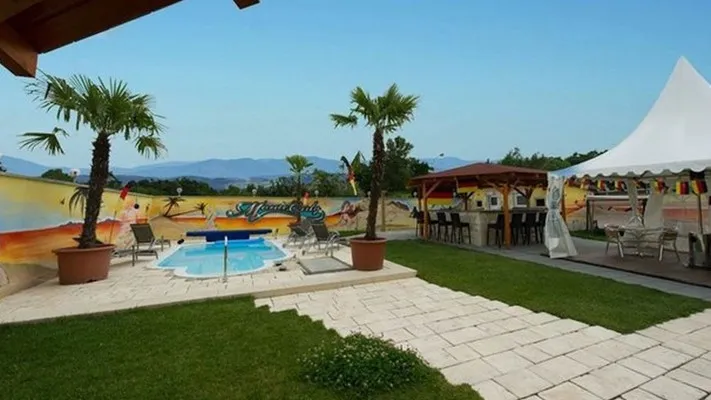
FKK Monte Carlo Baden-Baden (D)
Am Badweg 1, 76532 Baden-Baden
Last updated on
Something wrong or missing?
Prices, opening times and all features · FKK Monte Carlo Baden-Baden (D)
Features
Yes · 10
- Outdoor area (garden)
- Food included
- Free parking
- Adult cinema
- Valuables lockers
- Finnish sauna
- Screened parking
- Soft drinks included
- Live sport on TV
- Outdoor pool
No · 20
- Air conditioning
- Beer included
- Draught beer
- Card payment / ATM
- Cocktails
- Step-free access
- Free Wi-Fi
- Live DJ
- Live shows
- Professional massage
- Pick-up service
- Overnight stay possible
- Slot machines
- SM room
- Steam bath
- Indoor pool
- Solarium
- Hot dinner
- Indoor whirlpool
- Outdoor whirlpool
More features
Saunas, wellness, pools, garden with terrace and barbecue, lounge, bar, buffet, cinema, rooms and suites. Sky sports bar. No cameras, no mobile phones in the club. Free, guarded car park at the house, taxi rank in front of the entrance. Ten minutes from the A5.
Size / area
Medium-sized club
- Indoor
- 600 m²
- Outdoor
- 400 m²
What to expect at FKK Monte Carlo Baden-Baden (D)
Baden-Baden
- Name origin
- balneas, balneis (lat., = baths) --> Badon
- First documented mention
- 987 AD
- Population
- 55,000
- Area
- 140.19 km²
- Federal state
- Baden-Württemberg
- Administrative region
- Karlsruhe
- District
- /
- Vehicle registration
- BAD
- River
- Oos; also: Rhein (beyond the city limits)
The Club FKK Monte Carlo is located in Baden-Baden/Sandweier.
Baden-Baden lies close to the Baden Rhine plain in the valley of the Oos at the foot of the Black Forest, whose northwestern hilltops rise abruptly here and continue southward as a mighty mountain range. The Schwarzwaldhochstraße to Freudenstadt begins here and, as a spectacular panoramic road, lures countless day-trippers and holidaymakers to explore it every year. Baden-Baden is Germany's most prominent and world-renowned spa town, and with its buildings and parks it is entirely defined by its long spa tradition.
Even the name Baden reveals that the town has had a bathing tradition ever since Roman settlement. In 1046 the town's market rights were mentioned for the first time, and it developed into the capital of the Margraviate of Baden, until Baden-Baden was burned down by French troops on 24 August 1689 during the War of the Palatine Succession; as a result, the residence was moved to Rastatt. Over the centuries, the double name Baden-Baden became established as a way of distinguishing it from other towns of the same name, and it became official in 1931. The traditional use of Baden's thermal springs led to the introduction of the spa tax in 1507 and to the consistent expansion of spa operations. At the beginning of the 19th century, with the construction of the Kurhaus, the casino and numerous luxury hotels, the town developed into a glamorous spa resort and the summer capital of Europe, hosting countless distinguished guests from the nobility and upper middle class.
Given the town's pronounced character as a place of recuperation, it is generally a delight to explore the cityscape with its numerous green spaces. Among the tourist attractions worth mentioning are the magnificent park and garden grounds of the Lichtentaler Allee and Dahliengarten, the Gönneranlage, and the Mediterranean-style Florentinerberg with fantastic views over the spa and cultural town; furthermore the Caracalla Therme, the Friedrichsbad, the Villa Hamilton, the Paradies water feature, Kloster Lichtenthal, Schloss Hohenbaden, the Neues Schloss, the Brahmshaus, the Festspielhaus, the Trinkhalle Baden-Baden, the Kurhaus, the casino, the Theater Baden-Baden, the Staatliche Kunsthalle, the Museum Frieder Burda, the Fabergé Museum, the Philharmonie, and churches such as the Stiftskirche and the Russische Kirche. Naturally, given the immediately adjoining mountain ranges, there are also numerous hiking opportunities on circular and themed trails in the Black Forest National Park.
The glamour of the Belle Époque lives on in the town. Today, more than ever, Baden-Baden is an elegant international spa and cultural town with a shopping mile and glamorous flair, and a venue for numerous gala events and festivals. The Festspielhaus is Germany's largest concert and opera house and offers musical experiences, opera evenings and ballet performances with the resident orchestras of the Philharmonie Baden-Baden and the SWR Sinfonieorchester, as well as guest orchestras such as the Berliner Philharmoniker. Baden-Baden is also home to the annual Herbert von Karajan Pfingstfestspiele.
Well-known sons and daughters of Baden-Baden include Marie Prinzessin von Baden, Max von Baden, Louis II of Monaco, Egon Steigenberger, Manfred Sexauer, Tony Marshall, Wolfgang Grenke, Elmar Hörig, Isabell Hertel, and Sabine von Maydell.