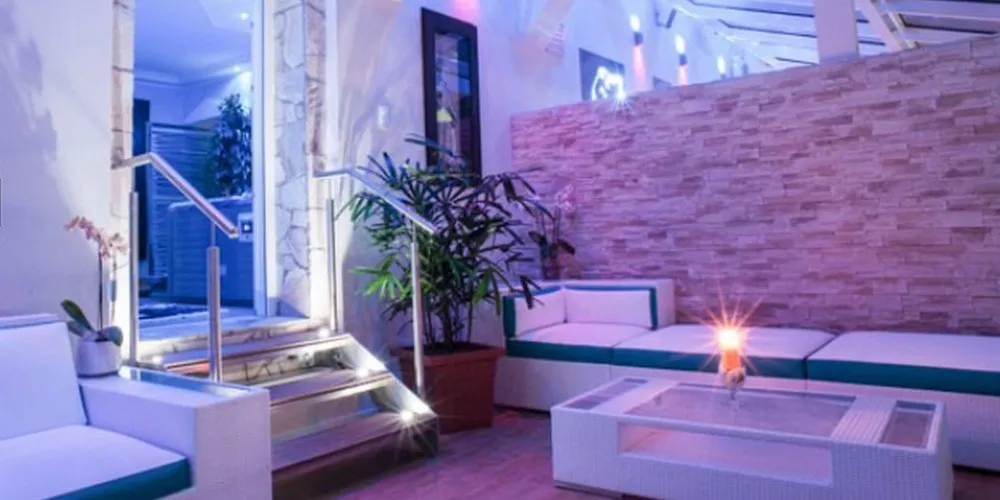
FKK Sunshine München (D)
Ludwigshafener Straße 1, 80686 München
Last updated on
Something wrong or missing?
Prices, opening times and all features · FKK Sunshine München (D)
Features
Yes · 12
- Outdoor area (garden)
- Food included
- Live shows
- Professional massage
- Adult cinema
- Finnish sauna
- SM room
- Soft drinks included
- Live sport on TV
- Hot dinner
- Indoor whirlpool
- Outdoor whirlpool
No · 18
- Air conditioning
- Beer included
- Draught beer
- Card payment / ATM
- Cocktails
- Step-free access
- Free parking
- Free Wi-Fi
- Live DJ
- Pick-up service
- Overnight stay possible
- Valuables lockers
- Screened parking
- Slot machines
- Steam bath
- Indoor pool
- Outdoor pool
- Solarium
More features
16 rooms. Sauna, six whirlpools, one of them outdoors, massages, outdoor area. Lounge with bar and pole-dance pole, table dance, erotic cinema, bizarre area, smoking lounge, bistro and à la carte. Live sports with Sky, DAZN and Prime.
Size / area
Small club
- Indoor
- 500 m²
What to expect at FKK Sunshine München (D)
München
Munich
Capital of the federal state of Bavaria
Name origin: forum apud Munichen (lat./ahd. munich=monk --> Place by the monks)
First documented mention: 1158 AD
Population: 1,488,000
Area: 310.70 km²
Administrative region: Munich
District: /
Vehicle registration: M
River: Isar, Würm
The club FKK Sunshine is located in München-Sendling-Westpark.
Munich is the largest city in Bavaria both in terms of area and population. Close to the state capital lies Germany's second-largest airport. The international airport (reachable via A92 and S-Bahn lines S1 and S8) handles nearly 40 million passengers a year. By car, Munich can be reached via the A8, A9, A92, A94, A95, A96 or A99.
Connected to numerous major cities, rail travel is also a great option for travellers. With trams, U-Bahns, countless taxis and other means of transport, Munich has a very well-developed transport network, making it quick and easy to reach sights, public facilities and more within Munich. Connections run every few minutes.
Munich is cosy. Munich is beautiful. Munich is dead expensive. Munich is a hoot and at the same time pure splendour, and thoroughly Upper Bavarian besides, albeit in its own particular way — Munich style, that is — a city that proudly displays its long-grown traditions while also being an ultra-modern, high-performing location operating at world-class level. The city traditionally holds a top spot in Germany-wide comparisons — if not worldwide — especially in economic, cultural and political terms. The metropolis is one of the most economically successful and fastest-growing in Europe. In the city ranking by the consultancy Mercer, Munich placed second for infrastructure and fourth for quality of life among fifty major cities worldwide in 2014. In the Zukunftsatlas 2016, the Munich district and the city of Munich rank 1st and 2nd out of 402 districts and independent cities in Germany, putting them among the places with "top future prospects." Here are a few highlights about the city:
Munich was first documented in 1158. The city became the seat of the Bavarian dukes in 1255, was the imperial residence city from 1328 to 1347, and became the sole capital of Bavaria in 1506. Towards the end of the 18th century, Munich grew rapidly, a development that accelerated further in 1806, when Bavaria was elevated to the Kingdom of Bavaria by Napoleon, making Munich the capital of a country twice as large. Under the reign of King Ludwig I of Bavaria (1825–1848), Munich became a widely renowned city of art. The classicists Leo von Klenze and Friedrich von Gärtner designed Ludwigstraße, Königsplatz and the extension of the Munich Residenz. Ludwig I's son, Max II, also emerged as a great builder, like his father. In the new "Maximilianstil," reminiscent of English Gothic, buildings such as those along Maximilianstraße were built — today one of the most exclusive and expensive shopping streets on the continent. Under Max II's brother, Prince Regent Luitpold (1886–1912), Munich then experienced an enormous economic and cultural upswing. Among other things, Prinzregentenstraße and the Prinzregententheater were built during this time. Around the turn of the century, Schwabing flourished as an artists' quarter, frequented by numerous significant writers and painters of the time. Der Blaue Reiter was founded in 1911 and eventually established Munich as a centre of modern art. Its members included Paul Klee, Wassily Kandinsky, Alexej von Jawlensky, Gabriele Münter, Franz Marc, August Macke and Alfred Kubin. In the years following World War I, Munich increasingly became a breeding ground for National Socialist activities. In 1923, the Hitler Putsch failed in Munich — Hitler's march on the Feldherrnhalle München. The National Socialists later honoured Munich as the "Capital of the Movement."
Marienplatz is considered the centre of Munich and lies, surrounded by the Neues Rathaus and the Altes Rathaus, in the heart of the old town. Just a few steps away is the Peterskirche, the oldest church in the old town, whose original building dates back to the Romanesque period. Surviving from the former city fortifications are the Isartor, the Sendlinger Tor, the Karlstor and the Löwenturm at Rindermarkt. The most important secular Gothic buildings are the Alter Hof, the Altes Rathaus with its dance hall, and the Zeughaus, which today forms part of the city museum. The Weinstadl, rebuilt during the Renaissance, survives as one of the oldest still-standing townhouses. The Eilleshof, built around 1560, is one of the last originally preserved old Munich arcaded courtyards. The Hofbräuhaus, founded in 1589, is today housed in a 19th-century building at the Platzl. Heading north towards Schwabing, Ludwigstraße was built between the Feldherrnhalle and the Siegestor. Along it lie the Bayerische Staatsbibliothek, the Ludwigskirche and the Ludwig-Maximilians-Universität, as well as numerous state ministries. Also dating from the time of Ludwig I are the Theresienwiese and the Ruhmeshalle built there, including the colossal bronze statue of Bavaria.
The oldest garden complex is the Hofgarten from the Renaissance period, with the Dianatempel. Adjoining it to the northeast are the Finanzgarten and the Englischer Garten, laid out from 1789 onwards, which stretches from the city centre to the northern city boundary and, at 4.17 square kilometres, is larger than Central Park in New York. Schlosspark Nymphenburg was created to the west of Schloss Nymphenburg in the French style. In the 19th century, it was transformed into an English landscape garden, with the exception of the "Grand Parterre." Adjoining to the north is the Neuer Botanischer Garten. Southeast of Nymphenburg lies the former electoral Hirschgarten. No fewer than three baroque palaces are located on the northern city boundary within the park of Schloss Schleißheim; alongside Herrenhausen and Schwetzingen, it is the only surviving large baroque garden in Germany.
Among the modern buildings, the most architecturally noteworthy are the BMW-Vierzylinder at the Olympiapark, next to which the futuristic BMW Welt opened in October 2007, as well as the Hypo-Haus in Arabellapark and the Highlight Towers located in the north of Schwabing. The city's tallest high-rise, at 146 metres, is the Uptown München. The city's tallest structure overall is the 291-metre-high Olympiaturm. Especially after the turn of the millennium, numerous high-rises were also built in Munich, such as the 146m Uptown high-rise and the twin Highlight Towers, the SV-Hochhaus completed in 2008, or the Skyline Tower. Since a referendum in 2004, in which the majority of participating Munich voters voted against the construction of buildings taller than 100 metres, no high-rise has been built in the Bavarian state capital that exceeds the twin towers of Munich's landmark, the Frauenkirche, built in 1488 — which, including their striking Renaissance domes, stand at just under 99 metres.
Munich is internationally renowned for its collections of old and classical art, presented in state, municipal and private museums and galleries alike. The Alte Pinakothek and the Neue Pinakothek, as well as the Pinakothek der Moderne and the Lenbachhaus — significantly extended in 2014 — are among the most important galleries in the world. Together with the Glyptothek, the Staatliche Antikensammlungen and the Museum Brandhorst, these collections form the Kunstareal München. The Staatliches Museum Ägyptischer Kunst also received a new building within the Kunstareal. The Deutsches Museum, with technical exhibits unique in the world, is among the most-visited museums in Europe with over one million visitors a year, and is the largest museum of technology and natural science in the world.
Munich boasts a very rich theatre, ballet and opera culture, with five state, three municipal and over fifty private stages. The Bayerische Staatsoper in Munich is among the most renowned opera houses in the world and looks back on a remarkable history and tradition. Premieres noted throughout Europe already took place around 1700. In the field of spoken theatre, the city's most important stages are the Bayerisches Staatsschauspiel, the Münchner Kammerspiele and the Münchner Volkstheater.
Economy:
Important sectors of Munich's economy include tourism, vehicle and mechanical engineering, electrical engineering, and the software and IT industry. The high density of IT companies has also earned Munich the nickname "Isar Valley." Munich is also a major financial centre and Germany's insurance hub. Munich is home to numerous corporations, including seven DAX companies (Allianz, BMW, Münchener Rück, Siemens, Infineon, Wirecard, MTU, and until 2018 also Linde). It is home to Bavaria's only stock exchange. As a media hub, the city is of nationwide significance. Munich is home to more publishing houses than any city in the world except New York. The television and film industries are strongly represented in the city and its immediate surroundings (television industry in Unterföhring and film industry in Geiselgasteig). With Constantin Film, Bavaria Film and other companies, Munich is also one of the leading film cities. Munich is the seat of the Bayerischer Rundfunk, the programme direction of the ARD joint programme Das Erste, and the ZDF regional studio for Bavaria. Furthermore, Munich and its immediate surroundings host numerous private television and radio broadcasters such as RTL II, ProSiebenSat.1 Media (ProSieben, Sat.1, kabel eins), Tele München Gruppe, Sport1, Sky Deutschland, München TV.
Oktoberfest is the world's largest folk festival and generates more revenue for the city of Munich within two weeks than some industrial conglomerates achieve in a whole year.
Munich has been the seat of the Archdiocese of Munich and Freising since 1817, one of the wealthiest dioceses in Germany.
In 1846, the Irish dancer Lola Montez came to Munich and became the mistress of King Ludwig I. She was given a luxurious villa on Barer Straße in Munich, a title of nobility (Countess of Landsfeld) and financial support from Ludwig. The affair caused a sensation across Europe. On 20 March 1848, Ludwig I voluntarily abdicated in favour of his firstborn son, Maximilian II.
Ludwig II of Bavaria (1845–1886) left his mark on Bavarian history as a passionate builder of palaces, above all Neuschwanstein, Herrenchiemsee and Linderhof; he is also known as the Fairy-tale King. He ruled Bavaria from 1864. After he was declared incapacitated on 9 June 1886, his uncle Luitpold took over the reins of government in the Kingdom of Bavaria as Prince Regent. Four days later, Ludwig II drowned in the Würmsee (officially renamed Starnberger See in 1962). Schloss Neuschwanstein is one of Germany's most famous sights.
Franz Josef Strauß was arguably the most combative, brilliant and cunning politician of German post-war history. He was a member of the federal government as Federal Minister for Special Affairs (1953–1955), Federal Minister for Atomic Affairs (1955–1956), Federal Minister of Defence (1956–1962) and Federal Minister of Finance (1966–1969). From 1978 to 1988 he was Bavarian Minister-President.
On average ten days a year, Munich experiences Föhn, a warm, dry downslope wind from the main Alpine ridge that produces such excellent visibility that the Bavarian Alps can be clearly seen from within the city.
Italy is no longer far from Munich and can be reached quickly and easily for an extended weekend. In Munich, especially in the gastronomic sector, there is an extensively established Italian culture in the cityscape. That's why Munich is also fondly referred to as the northernmost city of Italy.
FC Bayern München is one of the most successful football clubs in Europe. It was founded on 27 February 1900 and, with around 290,000 members, is the sports club with the most members in the world.
Well-known sons and daughters of Munich include Ludwig II, Sissy, Richard Strauss, Karl Valentin, Lion Feuchtwanger, Franz Marc, Sophie Scholl, Christian Morgenstern, Carl Orff, Golo Mann, Franz Josef Strauß, Curd Jürgens, Beppo Brem, Gustl Bayrhammer, Walter Sedlmayr, Marianne Koch, Maxl Graf, Helmut Fischer, Heinrich Hugendubel, Peter Kraus, Robert Lembke, Werner Herzog, Rudolph Moshammer, Max Greger, Hugo Strasser, Fritz Wepper, Sascha Hehn, Horst Jüssen, Heidi Brühl, Chris Roberts, Michaela May, Rainer Erler, Suzanne von Borsody, Ute Willing, Olivia Pascal, Wolfgang Fierek, Georg Schwarzenbeck, Franz Beckenbauer, Uschi Obermaier, Konstantin Wecker, Jutta Speidel, Dominik Graf, Joseph Vilsmaier, Robert Havemann, Harry Valérien, Thomas Ohrner, Silvia Seidel, Jeanette Hain, Ralph Siegel, Giulia Siegel, Marianne Hartl, Franz Xaver Kroetz, Martina Gedeck, Marion Kracht, Alexander Held, Barbara Schöneberger, Nina Eichinger, Constanze Engelbrecht, Ulrich Noethen, Sonja Maischberger, Moritz Bleibtreu, Philipp Lahm, Michael Herbig, Maria Furtwängler and Harold Faltermeyer.