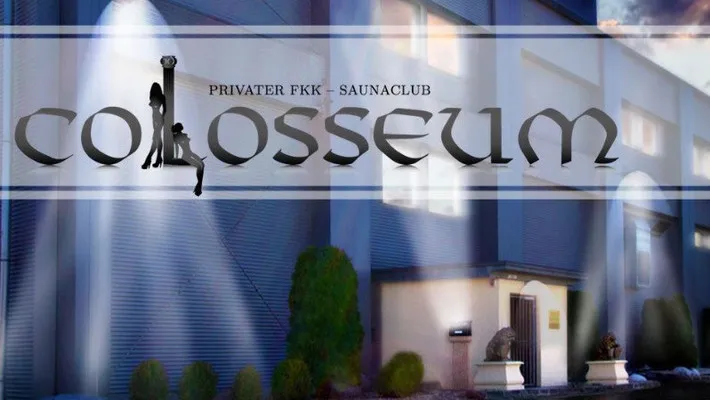
FKK Colosseum Augsburg (D)
Gubener Straße 13, 86156 Augsburg
Last updated on
Something wrong or missing?
Prices, opening times and all features · FKK Colosseum Augsburg (D)
Features
Yes · 7
- Outdoor area (garden)
- Food included
- Finnish sauna
- Soft drinks included
- Indoor pool
- Solarium
- Indoor whirlpool
No · 23
- Air conditioning
- Beer included
- Draught beer
- Card payment / ATM
- Cocktails
- Step-free access
- Free parking
- Free Wi-Fi
- Live DJ
- Live shows
- Professional massage
- Pick-up service
- Adult cinema
- Overnight stay possible
- Valuables lockers
- Screened parking
- Slot machines
- SM room
- Live sport on TV
- Steam bath
- Outdoor pool
- Hot dinner
- Outdoor whirlpool
Size / area
Large club
- Indoor
- 2400 m²
- Outdoor
- 100 m²
What to expect at FKK Colosseum Augsburg (D)
Augsburg
- Name origin
- Augusta Vindelicorum (lat., = named as the city of Emperor Augustus for the Vindelici tribe)
- First documented mention
- 15 BC
- Population
- 296,000
- Area
- 146.85 km²
- Federal state
- Bavaria
- Administrative region
- Schwaben
- District
- /
- Vehicle registration
- A
- River
- Wertach-->Lech
The Club FKK Colosseum is located in Augsburg-Oberhausen-Süd.
Who would have thought: Der Räuber Hotzenplotz is the most popular piece of the Augsburger Puppenkiste, the marionette theatre that surely every child who grew up in Germany knows because of the TV shows broadcast nationwide over decades. Less well known is that the theatre also stages pieces for adults, making it in any case one of the city's tourist highlights.
Bavaria's largest Swabian city, however, has more to offer than just puppet theatre. Like several other prominent German cities, Augsburg emerged from an old Roman fort and thus ranks among the oldest cities in Germany. The Battle of the Lechfeld near Augsburg in the year 955 under Otto the Great, which put an end to decades of Hungarian invasions, is considered the very birth hour of the Germans. The city looks back on a proud and rich history reaching back into the Middle Ages, reflected in the cityscape among other things by the old city wall, the Perlachturm and the neighbouring majestic town hall, the splendid fountains, and the venerable cathedral.
The name of Augsburg is inseparably linked with the merchant families of the Welser and, in particular, the Fugger, who at the beginning of the modern era built decisive trade connections throughout Europe and thereby achieved such great economic prosperity that in the 15th and 16th centuries, as financiers of the Habsburgs and the Vatican, they influenced European politics in a significant way. According to current findings, Jakob Fugger, with a fortune equivalent to 400 billion dollars, is considered the richest man in world history. Relics of the Fuggers' activities in Augsburg include the Fuggersche Stadtpalast, the Fuggerhäuser and the Fuggerei, the oldest surviving social housing settlement in the world.
As an important trading city, Augsburg was one of the most significant cities in the Holy Roman Empire; following this rich trading tradition, there is still today a striking density of companies from the financial sector such as Fürst Fugger Privatbank, Bankhaus Hafner and Augsburger Aktienbank. In addition, numerous industrial companies are based in Augsburg, such as MAN, manroland, Renk, LEDvance, UPM-Kymmene, MT Aerospace, BMK, KUKA, Böwe Systec, Kontron, Betapharm and also Patrizia Immobilien. As a curious testament to Augsburg's trading activities, one may finally also interpret the fact that the city is considered Germany's whore stronghold, with the most prostitutes relative to its population.
Augsburg is one of the greenest cities in Europe, reflected in numerous parks such as the Zentrumspark, the Botanical Garden as well as the zoo, the Wittelsbacher Park and the Hofgarten on the grounds of the Augsburg bishop's residence. Since 1970 Augsburg has also been a university town and accordingly has campus green spaces.
Among the well-known sons and daughters of Augsburg are Hans Holbein the Elder, Jakob Fugger, Agnes Bernauer, Leopold Mozart, Maria Anna Thekla Mozart, Bertold Brecht, Magda Schneider, Helmut Haller, Tilo Prückner, Hans W. Geißendörfer, Elmar Wepper, Roy Black, Jürgen Möllemann, Helmut Haller, Bernd Schuster, Tina Schüßler and Andreas Bourani.