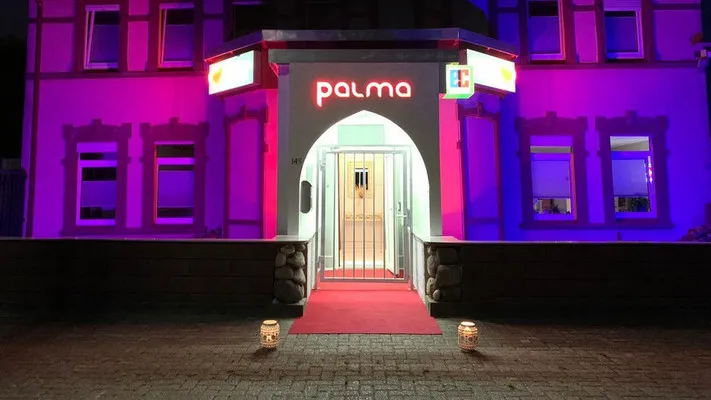

Palma Wilhelmshaven (D)
Ebkeriege 145, 26389 Wilhelmshaven
Last updated on
Something wrong or missing?
This club has closed for good.
Club Palma is closed.
Clubs nearby · Palma Wilhelmshaven (D)
Prices, opening times and all features · Palma Wilhelmshaven (D)
Features
Yes · 10
- Outdoor area (garden)
- Draught beer
- Card payment / ATM
- Free parking
- Adult cinema
- Finnish sauna
- Screened parking
- Soft drinks included
- Solarium
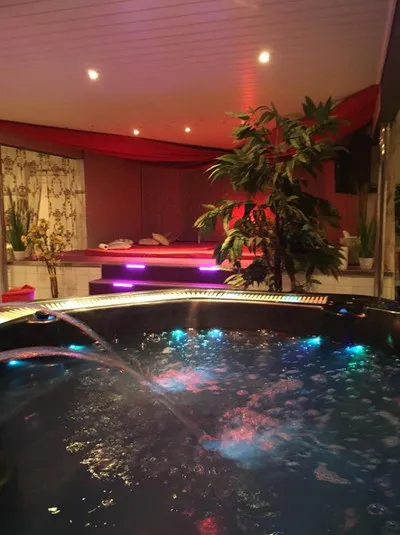
- Indoor whirlpool
No · 20
- Air conditioning
- Beer included
- Cocktails
- Step-free access
- Food included
- Free Wi-Fi
- Live DJ
- Live shows
- Professional massage
- Pick-up service
- Overnight stay possible
- Valuables lockers
- Slot machines
- SM room
- Live sport on TV
- Steam bath
- Indoor pool
- Outdoor pool
- Hot dinner
- Outdoor whirlpool
More features
Size / area
Small club
- Indoor
- 800 m²
- Outdoor
- 50 m²
What to expect at Palma Wilhelmshaven (D)
Wilhelmshaven
- Name origin
- named after King Wilhelm I of Prussia
- First documented mention
- 1869; founded by King Wilhelm I of Prussia as a naval base
- Population
- 75,000
- Area
- 107.07 km²
- Federal state
- Niedersachsen
- District
- /
- Vehicle registration
- WHV
- River
- Maade, Ems-Jade-Kanal; Wilhelmshaven lies on the Jadebusen on the North Sea
The Club Palma is located north of Mariensiel and the JadeWeser Airport.
The exposed location on the Jadebusen, a large bay not far from the mouth of the Weser into the North Sea, is what defines Wilhelmshaven. The coastal marshland of this area was historically traditionally settled by Frisians and belonged to the parishes of Heppen and Neuende in the Grand Duchy of Oldenburg. As part of the so-called Jade Treaty, Prussia purchased an area of around 300 hectares on the Jadebusen in 1853 to build a base for the Prussian navy. Since then, the history of Wilhelmshaven has been closely linked to the history of the Prussian and German navy. The newly founded city, named after King Wilhelm I, was granted town rights as early as 1873 and today is not only the largest base of the German navy, but also by far the largest site of the Bundeswehr, the German army. In addition, Wilhelmshaven, as the German deep-sea port par excellence, is significant as an oil transshipment port and, as a result, also as a settlement area particularly for the petrochemical industry. With the Eurogate terminal, the city also has an important container transshipment hub. Although Wilhelmshaven has suffered in recent decades from the weak economic structure of the northwest German region, the city is of course shaped by the shipping and shipyard industry, port economy, chemical and metal industry, and the German navy. Besides the Bundeswehr, major employers in the region include the companies Ineos, Vynova, HES, Manitowoc Crane Group, ALBA Metall Nord, JadeWeser Port, E.on, and GDF Suez. The international JadeWeser Airport is located in the marshland area of Mariensiel.
Wilhelmshaven's cityscape is characterised by recreational facilities such as the Rüstringer Stadtpark, the Rosarium, the Kurpark, the Störtebeker Park, and the Botanischer Garten. The city's landmarks, on the other hand, are the maritime Kaiser-Wilhelm-Brücke from the year 1907, the largest swing bridge in Germany, as well as the striking clinker-brick Rathaus from the year 1929. Within the city's territory, besides two historic windmills worth seeing, there are two historic castles; the chieftain's castle Burg Kniphausen, built in 1438, on the western outskirts of Wilhelmshaven, and the Sibetsburg, which recalls the era of the Vitalienbrüder.
As a North Sea city, Wilhelmshaven is home to the Jade Hochschule as well as scientific research institutions such as the Senckenberg Institute for Marine Geology and Biology, the Lower Saxony Institute for Historical Coastal Research, the Institute for Avian Research, the German Wind Energy Institute, and the Terramare Marine Research Institute. In addition, the city attracts holiday guests with its shopping opportunities and tourist facilities, particularly from the surrounding seaside resorts of the East Frisian coastal region. Among the city's tourist attractions is also the Deutsches Marine-Museum; opposite the Marine-Museum is another outstanding sight, the UNESCO World Heritage Wadden Sea Visitor Centre for the Niedersächsisches Wattenmeer National Park. Wilhelmshaven's calendar of events is particularly shaped by maritime events such as the Wochenende an der Jade, the Südstrandwochenende, and the JadeWeserPort-Cup.
Wilhelmshaven has been part of the Metropolregion Oldenburg/Bremen since 2006.