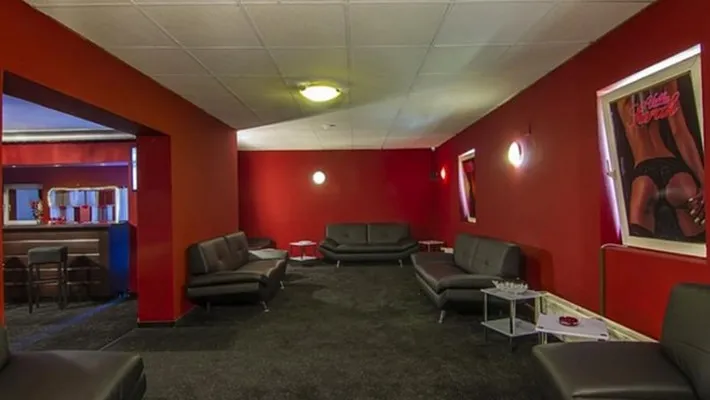
FKK Villa Erotica Iserlohn (D)
Dröscheder Berg 4, 58638 Iserlohn
Last updated on
Something wrong or missing?
This club has closed for good.
Clubs nearby · FKK Villa Erotica Iserlohn (D)
Prices, opening times and all features · FKK Villa Erotica Iserlohn (D)
Features
Yes · 9
- Outdoor area (garden)
- Free parking
- Adult cinema
- Valuables lockers
- Finnish sauna
- Screened parking
- Slot machines
- Soft drinks included
- Hot dinner
No · 21
- Air conditioning
- Beer included
- Draught beer
- Card payment / ATM
- Cocktails
- Step-free access
- Food included
- Free Wi-Fi
- Live DJ
- Live shows
- Professional massage
- Pick-up service
- Overnight stay possible
- SM room
- Live sport on TV
- Steam bath
- Indoor pool
- Outdoor pool
- Solarium
- Indoor whirlpool
- Outdoor whirlpool
Size / area
Small club
- Indoor
- 400 m²
- Outdoor
- 20 m²
What to expect at FKK Villa Erotica Iserlohn (D)
Iserlohn
- Name origin
- îse(r)n, lô(ch), (Middle Low German, = iron forest)
- First documented mention
- 1150 AD
- Population
- 92,000
- Area
- 125.49 km²
- Federal state
- Nordrhein-Westfalen
- Administrative region
- Arnsberg
- District
- Märkischer Kreis
- Vehicle registration
- MK
- River
- Lenne
The club FKK Villa Erotica is located in Iserlohn-Dröscheder Feld.
Iserlohn is a town in the Märkischer Kreis in Nordrhein-Westfalen. It lies in Südwestfalen in the south-eastern fringe zone of the Ruhrgebiet, about 25 km east of Hagen, and can be reached via the A46 motorway and a total of six railway stations located within the town area.
The town area stretches from the valley of the Ruhr in the north up to the heights of the Naturpark Sauerland-Rothaargebirge in the south; directly to the south of the town area lies the Iserlohner Höhe, whose highest point reaches 545 m above sea level. This gives the townscape its considerable differences in elevation and its extensive woodland.
In the Middle Ages Iserlohn lay within the sphere of influence of the Archbishopric of Cologne; secular rulers included the Counts of Werl, the Dukes of Berg and the Counts of Altena, who at the beginning of the 13th century divided their territories into the counties of Mark and Limburg; present-day Iserlohn lay exactly on the boundary between the two. In 1237 Iserlohn was granted town rights by Count Adolf I of the Mark. After the Jülich-Klevischen Erbfolgestreit (1609–1614), the County of Mark was taken over by the Electorate of Brandenburg and from then on belonged to Brandenburg-Preußen, later the Kingdom of Prussia.
As the town's name already suggests, Iserlohn has always been a centre of metalworking. As early as the Middle Ages, armour was made in the town, and later wire and needles. Products of the bronze and brass industry also counted among the town's important goods. From the 18th century onwards, Iserlohn rose to become Prussia's most important industrial town. Today the town is home to a balanced mix of businesses in the industrial and service sectors, with traditional metalworking still playing a major role.
Especially since the end of the 19th century, the Iserlohn town area has repeatedly been reshaped. In its present municipal structure, Iserlohn has consisted since 1 January 1975 of the districts Innenstadt, Wermingsen, Nußberg, Gerlingsen, Hombruch, Iserlohner Heide, Dröscheder Feld, Obergrüne, Sümmern, Hennen, Letmathe and Kesbern.
Iserlohn's landmark is the Danzturm on the Fröndenberg in the Iserlohner Stadtwald. Also worth seeing is the St.-Pankratius-Kirche, or Bauernkirche, the oldest surviving building in the town, dating from the year 985. Right next to the church stands the Haus der Heimat from 1720, which today serves as the town's local history museum. On the Seilerkuppe in the Seilerwald near Hemer stands the Bismarckturm; it is a monument erected in honour of the former German Reich Chancellor Otto Fürst von Bismarck. Well known beyond the region is the old Herrenhaus Letmathe in the district of the same name, first mentioned as far back as the year 1036. Unique in Germany is the Deutsches Höhlenmuseum Iserlohn in the district of Obergrüne; it is the largest German museum dedicated to speleology.
Iserlohn is regarded as a town of hockey. Iserlohn teams are represented in the top German league in the disciplines of ice hockey, roller hockey and inline hockey alike.
Born in Iserlohn were the entrepreneurs Theodor Müllensiefen, Friedrich Soennecken and Hermann Diedrich Piepenstock; as well as the artists Wilhelm Wessel and Ernst Dossmann, the singer Sandy Wagner, the cabaret artist Jochen Busse and the astronaut Ulrich Walter.