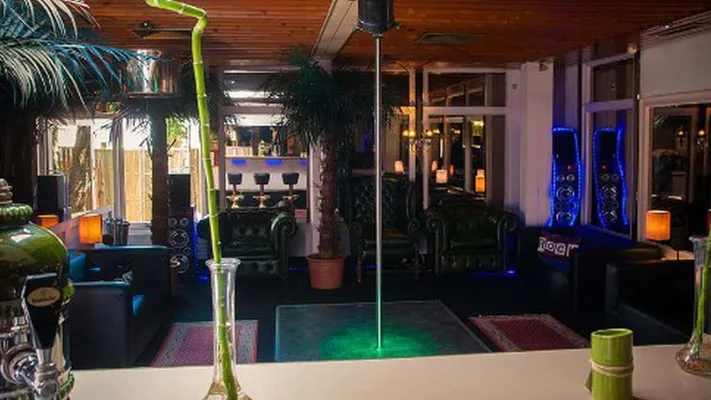
Sky Wuppertal (D)
Deutscher Ring 40, 42327 Wuppertal
Last updated on
Something wrong or missing?
Prices, opening times and all features · Sky Wuppertal (D)
Features
Yes · 14
- Outdoor area (garden)
- Beer included
- Food included
- Free parking
- Adult cinema
- Finnish sauna
- Slot machines
- Soft drinks included
- Live sport on TV
- Steam bath
- Indoor pool
- Outdoor pool
- Hot dinner
- Indoor whirlpool
No · 16
- Air conditioning
- Draught beer
- Card payment / ATM
- Cocktails
- Step-free access
- Free Wi-Fi
- Live DJ
- Live shows
- Professional massage
- Pick-up service
- Overnight stay possible
- Valuables lockers
- Screened parking
- SM room
- Solarium
- Outdoor whirlpool
More features
Size / area
Medium-sized club
- Indoor
- 900 m²
- Outdoor
- 300 m²
What to expect at Sky Wuppertal (D)
Wuppertal
- Name origin
- Wuppertal is a conglomerate of several small towns and has only existed as a unified major city since 01.08.1929. The city's name came about as a result of a public survey and came into effect a little later on 25.01.1930; it refers to the valley of the Wupper known as the Wuppersenke, on whose northern and southern banks the city mostly spreads out over steep hillsides.
first documented mention of districts: Cronenberg 1050 AD, Barmen 1070 AD, Elberfeld 1161 AD, Schöller 1182 AD, Ronsdorf 1246 AD, Beyenburg 1298 AD, Langerfeld 1304 AD, Dönberg 1355 AD, Vohwinkel 1356 AD
Population: 355,000
Area: 168.39 km²
Federal state: Nordrhein-Westfalen
Administrative region: Düsseldorf
District: /
Vehicle registration: W
River: Wupper
The Club Sky is located in Wuppertal-Elberfeld-West.
Wuppertal is one of the hilliest and, at the same time, greenest cities in Germany. The city owes both of these to the massive ridges of the Bergisches Land uplands on either side of the Wupper, which winds its way through the city in the Wuppersenke and is spanned by the public transport system of the Schwebebahn, opened in 1901, which is considered the city's landmark. This also makes it a city of stairs, the best-known of which is the Tippen-Tappen-Tönchen in Elberfeld. Because of its character as a merger of several towns, the city has no clear, historically grown city centre; generally, Elberfeld and Barmen are regarded as its urban centres.
Even though the city's name is not even 100 years old, its districts were already being settled by Franks and Saxons from the 7th century onwards. The construction of a first church in Sonnborn is documented for the year 874. In the Middle Ages the region was a county and was administered from Burg Elberfeld and Burg Beyenburg. With the age of industrialisation, the Wuppertal region then experienced a tremendous rise, above all in the textile and metal industries, as well as a supplier of raw materials for the neighbouring Ruhr area. In Elberfeld, Friedrich Bayer, who came from Wuppertal-Barmen, founded the parent company of Bayer AG in 1863. Today, Wuppertal boasts a rich portfolio of businesses across all sectors.
At the same time, the city is a university town and home to further institutes of higher education, giving Wuppertal, alongside a young and creative population, a colourful cultural diversity as well. Examples worth mentioning here are the museum landscape - one of the city's many famous sons is the co-founder of communism, Friedrich Engels; the Engels-Haus today forms, together with the Museum für Frühindustrialisierung, the so-called Historisches Zentrum - as well as the city's importance in dance culture: the dancer Pina Bausch died in Wuppertal on 30 June 2009 at the age of 69. She led the Tanztheater named after her in Wuppertal and was regarded as the most significant choreographer of her time.
The list of listed buildings in Wuppertal is endless and the second most extensive in NRW. Because of the city's particular industrial-historical development, most buildings date from the classicist era. The magnificent sandstone building of the Historische Stadthalle on the Johannisberg, completed in 1900 not far from Elberfeld train station - one of Wuppertal's most important sights - is, by contrast, built in the style of Italian neo-Renaissance and serves as the concert hall of the Sinfonieorchester Wuppertal. It is one of the most beautiful ballrooms and, with its immense organ, one of the acoustically best concert halls in Europe.
Wuppertal Zoo is the third-largest zoological garden in Germany.
Among Wuppertal's well-known sons and daughters are Friedrich Engels, Friedrich Bayer, Wilhelm Gustav Dyckerhoff, Wilhelm Dörpfeld, Carl Duisberg, Julius Richard Petri, Else Lasker-Schüler, Helene Stöcker, Gertrud Höhler, Ferdinand Sauerbruch, Wilhelm Deffke, Erich Ribbeck, Harald Leipnitz, Ann-Kathrin Kramer, Jörg Knör, Bettina Tietjen, Horst Tappert, Hans Günter Winkler, Johannes Rau, Rita Süssmuth, Alice Schwarzer, Wolf Erlbruch, Tom Twyker, Christoph Maria Herbst, Sascha Gutzeit, Patrick Stanke, Tanya Stewner, Gonzalo Castro, Silvana Koch-Mehrin and Sandy Mölling.