Römer Saunawelt Radebeul/Dresden (D)
Kolbestraße 2-4, 01445 Radebeul
Last updated on
Something wrong or missing?
This club has closed for good.
Clubs nearby · Römer Saunawelt Radebeul/Dresden (D)
Prices, opening times and all features · Römer Saunawelt Radebeul/Dresden (D)
Features
Yes · 11
- Outdoor area (garden)
- Draught beer
- Food included
- Free parking
- Adult cinema
- Finnish sauna
- Screened parking
- Slot machines
- Indoor pool
- Solarium
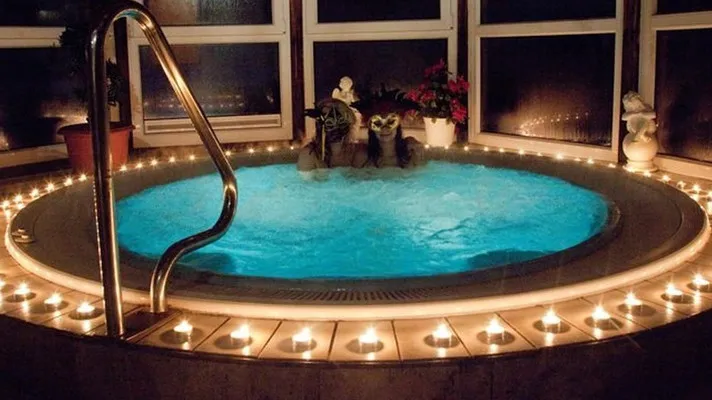
- Indoor whirlpool
No · 19
- Air conditioning
- Beer included
- Card payment / ATM
- Cocktails
- Step-free access
- Free Wi-Fi
- Live DJ
- Live shows
- Professional massage
- Pick-up service
- Overnight stay possible
- Valuables lockers
- SM room
- Soft drinks included
- Live sport on TV
- Steam bath
- Outdoor pool
- Hot dinner
- Outdoor whirlpool
Size / area
Large club
- Indoor
- 1900 m²
- Outdoor
- 100 m²
What to expect at Römer Saunawelt Radebeul/Dresden (D)
Radebeul
- Name origin
- Radebůl (Old Sorbian, Rad+Beil)
- First documented mention
- 1349 AD
- Population
- 34,000
- Area
- 26.14 km²
- District
- Meißen
- Vehicle registration
- MEI, GRH, RG, RIE
- River
- Elbe, Lößnitzbach
The club Römer Saunawelt is located in Radebeul-Ost.
It really is remarkable: the small town of Radebeul, right on Dresden's northern edge, borders directly on the overpowering capital of the Free State of Saxony, yet it can position itself quite impressively in comparison. For instance, the Landesoper Sachsen, Germany's second-largest touring theatre, has its seat in Radebeul. Karl May lived in Radebeul for many years together with his wife and universal heir Klara; his "Villa Shatterhand" today houses the Karl-May-Museum. The Mays were laid to rest in the Radebeul-Ost cemetery. Also connected to the Mays were their publisher Euchar Albrecht Schmid and his son Lothar Schmid, who, besides this work, became especially known as a chess grandmaster and "chess arbiter of the century." The Chemische Fabrik v. Heyden in Radebeul was the world's first pharmaceutical factory to produce a medicinal substance, salicylic acid, on an industrial scale. It was set up in 1874 by the chemist Friedrich von Heyden at Meißner Straße 35. It developed into one of Saxony's most important chemical companies and, at the same time, marked the beginning of Radebeul's industrialisation. The chemist Richard Seifert (1861–1919) had already, as assistant to Professor Rudolf Schmitt, played a key role in developing the salicylic acid synthesis. Later resident in Radebeul and director of the Chemische Fabrik v. Heyden based there, he developed the formula for Odol in 1891/1892 and handed it over to his friend, the Dresden entrepreneur Karl August Lingner, for marketing. His groundbreaking work earned him the nickname "chemist by God's grace."
The Radebeul chemist Richard Müller (1903–1999) also worked at the Chemische Fabrik v. Heyden. During his research, he succeeded in 1941 in the technical production of methylchlorosilanes, the starting products for the manufacture of silicones. Since then he has been regarded as the father of silicones.
In 1902, the engineer Johannes Wilhelm Hofmann founded the first "factory for electrical apparatus" in Radebeul-Kötzschenbroda. From 1929 to 1945 the Madaus company had its headquarters in Radebeul. During this time, the immune-stimulating Echinacin was introduced. Radebeul is also the origin of Nudossi, the hazelnut-nougat spread made by manufacturer Vadossi, as well as teas of the Teehaus brand from Teehaus GmbH, the second-largest production site of the worldwide Teekanne Group.
The shine of being an important Saxon industrial town has largely faded by now, so that today Radebeul's original, old-world charm stands out once more: the wine, villa and garden town of Radebeul, with its eight historic village cores and two villa quarters, lies along the old post road between the former royal seat of Dresden and the former episcopal seat of Meißen, and between the Elbe to the south and the vineyard slopes to the north — and is, thanks to its charming location, also called the "Saxon Nice."
For the 850th anniversary of the first mention of a Radebeul district, the first village and school festival took place in Naundorf in 1994. The town looks back on a long history: in 929, the Meißen castle was built in the course of the Frankish eastward expansion; Frankish and Saxon settlers were established in the area of Radebeul, and free farmers took over the Slavic settlements previously established here. In 1349, Radebeul was first documented in writing, while the first document concerning a building in Radebeul, the Friedenskirche in Kötzschenbroda, already dates back to 1275. In 1995, with the dissolution of the Landkreis Dresden, Radebeul joined the Landkreis Meißen and, with effect from 1 March 1995, was declared a Große Kreisstadt.
There is plenty to see in Radebeul: the town lies on the Sächsische Weinstraße with its numerous historic mills of the Lößnitz. The earliest records of winegrowing in Radebeul date back as far as 1271. This long tradition is also reflected in many winegrowers' houses, some still from the Baroque period, some built from the reddish syenite stone typical of the area, some in half-timbered style. The Baroque Schloss Wackerbarth serves as the seat of the Sächsisches Staatsweingut. Radebeul's vineyards are crossed by five wine hiking trails, each branching off from the Sächsischer Weinwanderweg.
On the edge of the hillside above the town, clearly visible from the valley below, stand a number of important Radebeul buildings: to the west, above Schloss Wackerbarth, the Jacobstein, and behind it the Volkssternwarte Adolph Diesterweg, which regularly offers public stargazing sessions and astronomy lectures. Further east stand the Bismarckturm and the Spitzhaus, with the Spitzhaustreppen leading down between them to the municipal winery Hoflößnitz. In the Hohenhaus in Radebeul-West, the writer Gerhart Hauptmann and his brother Carl Hauptmann met their future wives. The Villa Kolbe in Alt-Radebeul is a Neo-Renaissance building in the style of a Renaissance palace. The SSB Schmalspurbahnmuseum Radebeul found its home in the old building of the historic freight shed at Radebeul Ost station. Also worth seeing is the listed town hall, built in the style of German architecture around 1500. The best bit about this building: its foundation stone was laid on 9 August 1899.