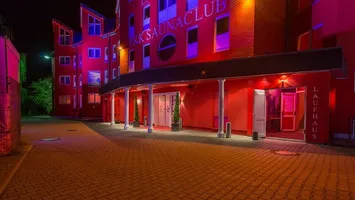
FKK Leipzig (D)
Torgauer Straße 246, 04347 Leipzig
Last updated on
Something wrong or missing?
Prices, opening times and all features · FKK Leipzig (D)
Features
Yes · 12
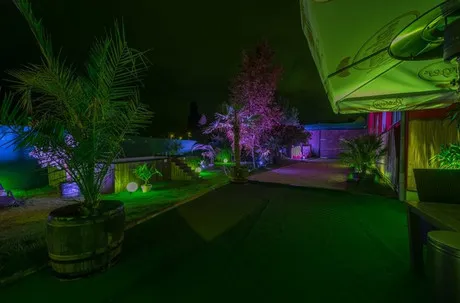
- Outdoor area (garden)
- Beer included
- Draught beer
- Food included
- Adult cinema
- Valuables lockers
- Finnish sauna
- Slot machines
- Soft drinks included
- Solarium
- Hot dinner
- Indoor whirlpool
No · 18
- Air conditioning
- Card payment / ATM
- Cocktails
- Step-free access
- Free parking
- Free Wi-Fi
- Live DJ
- Live shows
- Professional massage
- Pick-up service
- Overnight stay possible
- Screened parking
- SM room
- Live sport on TV
- Steam bath
- Indoor pool
- Outdoor pool
- Outdoor whirlpool
More features
Several saunas, whirlpools, tanning bed, relaxation area, sex cinema, bar, bistro, slot machines. Suites with private bathroom, VIP suites with lounge and whirlpool. Bathrobe, towels, bath slippers, changing locker and valuables safe. Couples welcome.
Size / area
Very large club
- Indoor
- 2400 m²
- Outdoor
- 800 m²
What to expect at FKK Leipzig (D)
Leipzig
- Name origin
- urbs Libzi (lat./sorb., = city of the linden trees)
- First documented mention
- 1015 AD
- Population
- 598,000
- Area
- 297.8 km²
- Administrative region
- Leipzig
- District
- /
- Vehicle registration
- L
- River
- Weiße Elster, Pleiße, Parthe
The Club FKK Leipzig is located in Leipzig-Schönefeld.
Leipzig is the largest city in the Free State of Saxony, an important trade fair city, home to Germany's second-oldest university after Heidelberg (Alma Mater Lipsiensis) and a major centre of cultural creativity, especially in the field of music. Johann Sebastian Bach and Felix Mendelssohn Bartholdy both worked here. In the Nikolaikirche, built in 1165 and the city's landmark, Bach performed his St John Passion for the first time on Good Friday 1724. The Monday prayers held in this church were the starting point in 1989 of the peaceful demonstrations against the GDR regime, which ultimately led to the fall of the Wall and German reunification. Another important sacred building is the Thomaskirche, where Johann Sebastian Bach's grave is located. The Thomanerchor, based here, enjoys worldwide renown, as does the Gewandhausorchester, which is at home not only in the Gewandhaus and the Leipzig Opera but also right here in the Thomaskirche.
The Völkerschlachtdenkmal in Leipzig commemorates the decisive battle of the Wars of Liberation against Napoleon in October 1813, which, with 600,000 soldiers involved, is considered the largest battle in world history up until the beginning of the 20th century.
The Leipziger Markt with the Altes Rathaus is the heart of the old town and one of the most splendid market squares in all of Germany, where the world-famous Leipziger Weihnachtsmarkt takes place every year. Directly opposite is the Mädler-Passage, which was lavishly restored after German reunification by the scandal-plagued construction magnate Jürgen Schneider. Here you can also stop in at Auerbachs Keller, Leipzig's second-oldest tavern, where Johann Wolfgang von Goethe often drank late into the night during his student days in Leipzig, and which he later helped make world-famous through the scene in Faust. „Uns ist ganz kannibalisch wohl, als wie fünfhundert Säuen!“
It's clear, then, that people have felt right at home in Leipzig since time immemorial. For those who still want to travel on, Airport Leipzig/Halle, Germany's second-largest airport by cargo volume, and especially Leipzig's main station, Europe's largest terminus station after Zurich, offer major transport hubs that stay in visitors' memories as Leipzig's calling card and are, in themselves, already a tourist attraction.
Among Leipzig's well-known sons and daughters are Gottfried Wilhelm Leibniz, Richard Wagner, Clara Schumann, Karl Liebknecht, Walter Ulbricht, Annemarie Renger, Gisela Uhlen, Mike Leckebusch, Frank Schöbel, Till Lindemann, Inka Bause, Utta Danella, Rolf Becker, Simone Thomalla, Heiko Thieme, Kristin Otto, Sebastian Krumbiegel and Bill Kaulitz.