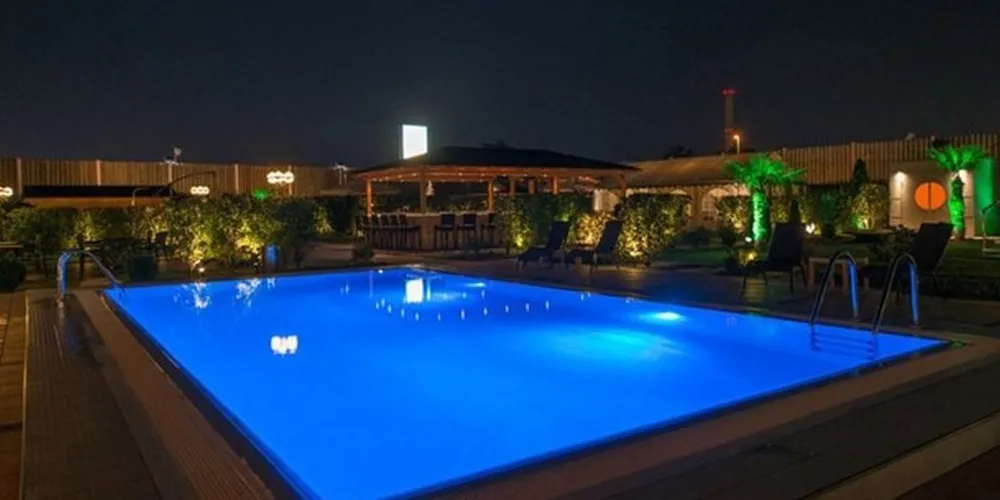
FKK Sharks Darmstadt/Frankfurt (D)
Otto-Röhm-Straße 72, 64293 Darmstadt
Laatst bijgewerkt op
Klopt er iets niet of ontbreekt er iets?
Kenmerken
Ja · 21
- Outdoor area (garden)
- Draught beer
- Card payment / ATM
- Step-free access
- Food included
- Free parking
- Professional massage
- Adult cinema
- Valuables lockers
- Finnish sauna
- Screened parking
- Slot machines
- SM room
- Soft drinks included
- Live sport on TV
- Steam bath
- Outdoor pool
- Solarium
- Hot dinner
- Indoor whirlpool
- Outdoor whirlpool
Nee · 9
- Air conditioning
- Beer included
- Cocktails
- Free Wi-Fi
- Live DJ
- Live shows
- Pick-up service
- Overnight stay possible
- Indoor pool
Meer kenmerken
Grootte / oppervlakte
Zeer grote club
- Binnen
- 4000 m²
- Buiten
- 3000 m²
Wat je bij FKK Sharks Darmstadt/Frankfurt (D) kunt verwachten
Darmstadt
- Name origin
- Darmundestat (Germanic, meaning disputed)
- First documented mention
- approx. 1090 AD
- Population
- 160,000
- Area
- 122.07 km²
- Federal state
- Hessen
- Administrative region
- Darmstadt
- District
- /
- Vehicle registration
- DA
- River
- Darmbach
The club FKK Sharks is located in Darmstadt-Nord.
With just under 160,000 inhabitants, Darmstadt is the fourth-largest city in the state of Hessen and belongs to the Rhein-Main region. Thanks to the Technical University and other research institutions, the city was awarded the title "Wissenschaftsstadt" (City of Science) in 1997.
Getting there by train:
The main station of Darmstadt, opened in 1912 and later rebuilt to be barrier-free, is the second-largest station in Hessen after Frankfurt am Main and is accordingly well connected to Deutsche Bahn's long-distance network. Several Intercity and Intercity-Express lines connect the city directly with Karlsruhe, Berlin, Konstanz and other long-distance destinations. Via the elevated cross-platform, you can reach the trams and buses of the city's local transport network.
Getting there by car:
At the Darmstadt motorway triangle, the federal motorways A5 (towards Kassel/Basel) and A672 (Darmstadt feeder road) intersect.
Hotels: Right near the station you'll find the hotels Maritim, Intercity, B&B, Ibis Darmstadt and the Hotel Hornung. Further 3- and 4-star hotels can be found in the city centre. Depending on what standards a hotel should meet, it's worth taking a look at the relevant hotel review portals.
Frankfurt Airport can be reached from Darmstadt via the A5 motorway in just a few minutes. The A5 is also a magnificently developed panoramic road through the Upper Rhine Plain, offering a picturesque view of the hills of the Messel hill country and, further south, of the Vorderer Odenwald. The original scenic route in this area, and the corresponding natural landscape, is called the Bergstraße.
Economy:
The core sectors of Darmstadt's economic life are: the IT sector, chemicals/pharmaceuticals, mechanical engineering/mechatronics, hair cosmetics, as well as space and satellite technology. Its technology and research orientation characterises the city's economy. Since 2 December 2003, the element with atomic number 110 in the chemical periodic table has been named Darmstadtium (D) in honour of the Darmstadt-based Gesellschaft für Schwerionenforschung. Darmstadt is thus the only German city after which an element has been named.
Companies based in Darmstadt include the chemical and pharmaceutical corporation Merck KGaA, the oldest chemical-pharmaceutical company in the world, as well as Röhm GmbH, Carl Schenck AG, Wella, Döhler GmbH, Goldwell GmbH, Deutsche Telekom (t-online), Deutsche Post AG, Software AG, Wissenschaftliche Buchgesellschaft and the Technologie- und Innovationszentrum (TIZ) Darmstadt. Darmstadt also has an extensive publishing tradition.
Education:
Darmstadt is home to universities with a total of around 41,000 students. The most prominent among them is the Technische Universität Darmstadt, founded in 1877, with around 26,000 students. With approximately 13,000 students based in Darmstadt, the Hochschule Darmstadt is the second-largest institution.
Alongside the two major Darmstadt universities, there is also the Evangelische Hochschule Darmstadt (EHD), founded in 1971 and run by the Evangelical Church in Hessen and Nassau, and the Akademie für Tonkunst, founded in 1851 as a private music school.
History:
A deeper understanding of Hessen's state structures is not possible without knowledge of the outstanding position that Darmstadt held within Hessen for centuries. It was only with the founding of the federal state of Hessen after World War II that Darmstadt's political and administrative significance declined, as the larger Wiesbaden, which had suffered little destruction, was given preference as the state capital. Nevertheless, Darmstadt is still the administrative seat for 10 districts (Bergstraße, Darmstadt-Dieburg, Groß-Gerau, Hochtaunuskreis, Main-Kinzig-Kreis, Main-Taunus-Kreis, Odenwaldkreis, Offenbach, Rheingau-Taunus-Kreis, Wetteraukreis), 4 independent cities (Darmstadt, Frankfurt am Main, Offenbach am Main, Wiesbaden) and 3 special-status cities (Bad Homburg vor der Höhe, Hanau, Rüsselsheim am Main).
Around the year 1000, Darmstadt initially belonged to the so-called Wildbann Dreieich, then in 1002 came into the possession of the Bishopric of Worms, and in 1009 into the possession of the Bishopric of Bamberg. In 1013 it finally became a fief of the Bishopric of Würzburg and remained so until the Reichsdeputationshauptschluss of 1803, the final dissolution of the Holy Roman Empire. In the mid-13th century, the Counts of Katzenelnbogen built a moated castle near Darmstadt; in 1330, Emperor Ludwig the Bavarian granted town rights for Darmstadt to Count Wilhelm I of Katzenelnbogen.
With the associated market rights, the significance of the previously rather inconspicuous settlement grew rapidly, and the entire regional economy oriented itself towards the Darmstadt market. Over the course of the 14th and 15th centuries, the Counts of Katzenelnbogen repeatedly expanded and rebuilt the castle, until it had finally become a representative palace by the mid-15th century. Darmstadt became a secondary residence of the Katzenelnbogen family and experienced a first high point in its development. In 1479 the line of the Counts of Katzenelnbogen died out, and Darmstadt fell to Heinrich III of Hessen. As a result, Darmstadt's standing declined from an important secondary residence to a small outpost far from the Hessian centre of power in Kassel.
In 1567 Landgrave Philipp the Magnanimous of Hessen, one of the most significant territorial princes of his time, died, and Hessen was divided among his four sons. Wilhelm received the northern part, now called Hessen-Kassel, Ludwig received Hessen-Marburg, Philipp received Hessen-Rheinfels, and Georg received the southern part, now called Hessen-Darmstadt. As Landgrave Georg I ("the Pious"), he founded the Hessian collateral line Hessen-Darmstadt and turned the former outpost of Darmstadt into a respectable residential city. Since Philipp and Ludwig died childless in 1583 and 1604 respectively, these territories fell to the Kassel and Darmstadt lines respectively.
The inheritance dispute with Hessen-Kassel over the legacy of Hessen-Marburg, which began in 1604, but above all the outbreak of the Thirty Years' War in 1618, hit Darmstadt hard and led the city through several crises. It was only with Ludwig VI, from 1661 onward, that a period of peace returned, along with economic recovery. About 100 years later, Ludwig IX, who took up the office of Landgrave in 1768, imposed a rigorous austerity policy on the city. For Darmstadt, Ludwig IX's reign was a time of reform and political insignificance, as Ludwig moved his seat of government to Pirmasens. Ludwig's wife, Karoline von Hessen-Darmstadt, who unlike her husband often resided in Darmstadt, brought about the city's first cultural flowering. From 1771 onward she gathered around her the so-called "Kreis der Empfindsamen" ("Circle of the Sensitive"), which included, among others, the young Goethe. He gave her the honorary title "Die große Landgräfin" (The Great Landgravine). Ludwig X took over the rule in 1790 and moved the seat of government back to Darmstadt.
With the Reichsdeputationshauptschluss of 1803, Hessen-Darmstadt gained large additional territories. In 1806, Landgrave Ludwig joined the Confederation of the Rhine and was made Grand Duke by Napoleon I. The Grand Duchy of Hessen-Darmstadt - not to be confused with the Electorate of Hessen (Hessen-Kassel, also known as Kurhessen) - existed in its absolutist form from 1806 to 1819, after which it became a constitutional monarchy and lasted until 1919. Through Article 47 of the Vienna Congress Act, the Grand Duchy of Hessen was assigned further territories in 1815/16, including Worms, Alzey, Bingen and Mainz, an area known as Rheinhessen. The Grand Duchy of Hessen, with its residence in Darmstadt, reached its maximum extent during this period and dominated large parts of Hessen.
In 1815 the Grand Duchy joined the German Confederation and remained a member state until 1866. With its territories north of the Main, it belonged to the North German Confederation from 1867 to 1870 following the lost German War against Prussia (1866), and was a constituent state of the German Empire from 1871 to 1919. The once so significant Hessen-Kassel, meanwhile, became the Prussian province of Hessen-Nassau in 1868 and was absorbed into the Regierungsbezirk Kassel, which had already been formed in 1867.
After the November Revolution of 1918, Darmstadt's last Grand Duke, Ernst Ludwig, had to abdicate, and in 1919 Darmstadt became the capital of the newly founded People's State of Hessen with a republican constitution. In World War II, around 99% of Darmstadt's old town and city centre were ultimately destroyed. After the American occupation in 1946, Darmstadt, due to its devastated condition, was no longer chosen as the state capital of the newly founded state of Hessen. That role went to the by-then significantly larger Wiesbaden, which had been a rather unimportant place until around 1800 and only rose to prominence in 1806 as the capital of the newly formed Duchy of Nassau, which existed until 1866 and was later incorporated by Prussia, together with Kurhessen, into the newly created Prussian province of Hessen-Nassau.
Sights:
Altes Rathaus - Luisenplatz (centre of Darmstadt) - Staatstheater - Hessisches Landesmuseum - Mathildenhöhe with Art Nouveau houses (artists' colony), Hochzeitsturm and Russische Kapelle - Waldspirale (Friedensreich Hundertwasser residential complex), Residenzschloss with palace garden - Jagdschloss Kranichstein - Auferstehungskirche, Ludwigskirche - Mozartturm - Orangerie - Staatstheater - Haus der Geschichte (former state theatre) - Prinz-Georg-Garten with palace and Pretlack'sches Gartenhaus - Jugendstilbad (municipal bathhouse), Weißer Turm (former corner tower of the medieval city fortifications), Ludwigshöhe with the Ludwigsturm observation tower as well as the Volkssternwarte Darmstadt (public observatory) - Großer Woog.
Well-known sons and daughters of Darmstadt include Magdalena Sibylla von Hessen-Darmstadt, Justus von Liebig, Karl-Heinz Böhm, Otto Buchinger, Beno Gutenberg, Mirjam Pressler, Bruno Labbadia, Michael Spreng, Günter Strack, Minh-Khai Phan-Thi and the last Tsarina of Russia, Alix von Hessen-Darmstadt.