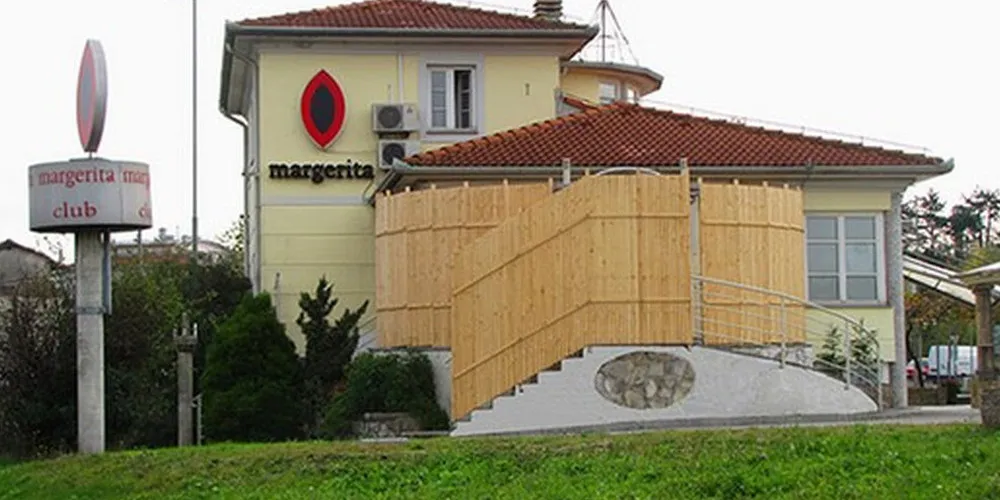



Margerita Nova Gorica (SLO)
Vojkova cesta 66, 5000 Nova Gorica
Last updated on
Something wrong or missing?
This club has closed for good.
Clubs nearby · Margerita Nova Gorica (SLO)
Prices, opening times and all features · Margerita Nova Gorica (SLO)
Features
Yes · 6
- Air conditioning
- Draught beer
- Cocktails
- Finnish sauna
- Steam bath
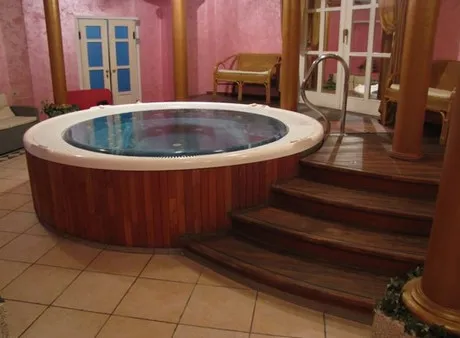
- Indoor whirlpool
No · 24
- Outdoor area (garden)
- Beer included
- Card payment / ATM
- Step-free access
- Food included
- Free parking
- Free Wi-Fi
- Live DJ
- Live shows
- Professional massage
- Pick-up service
- Adult cinema
- Overnight stay possible
- Valuables lockers
- Screened parking
- Slot machines
- SM room
- Soft drinks included
- Live sport on TV
- Indoor pool
- Outdoor pool
- Solarium
- Hot dinner
- Outdoor whirlpool
More features
Size / area
Small club
- Indoor
- 600 m²
What to expect at Margerita Nova Gorica (SLO)
Nova Gorica
- Name origin
- Historically, the city belongs to Gorizia (German: Görtz) in Italy. Its name refers to the Counts of Görtz, whose seat the city had been since the late Middle Ages. The Slavic variant "Gorizia/Gorica" is a diminutive of the Slovenian word "gora" and means something like "small hill".
- First documented mention
- 1948 AD
- Population
- 37,000
- Area
- 309 km²
- Statistical region
- Goriška
- Vehicle registration
- GO
- River
- Soča (Sontig/Isonzo)
The Club Margerita is located at the northern roundabout of the Mestni-Park in Nova Gorica.
Nova Gorica (German: Neu-Görz) is a border town in western Slovenia, directly on the Italian border. It historically belongs to the city of Görtz, which lies beyond the border in Italy and bears the name Gorizia. The city is traditionally trilingual (German/Italian/Slovenian) and is located about 65 km west of the capital Ljubljana (Laibach) and 35 km north of the Italian city of Trieste. Nova Gorica is the second largest city in Western Slovenia after the port city of Koper on the Adriatic coast.
Goertz was first documented in the year 1001 and had been the seat of the Counts of Görz since the late Middle Ages. After the count's family died out, its territory came to the Habsburgs around 1500 and thus subsequently to Austria. After the lost World War I, the entire territory, together with Istria, went to Italy under the Treaty of Saint-Germain.
At the Paris Peace Conference of 1946, also known as the Conference of the 21 Nations, the victorious powers of World War II negotiated the peace terms with the former allies of the German Reich - Italy, Romania, Hungary, Bulgaria and Finland. The treaties were signed on 10 February 1947. The Italian-Yugoslav peace treaty resulted in Italy ceding Istria, and Trieste was declared a "free city". One consequence of this treaty was that the city of Görz was divided by the new border line, with the main part remaining in Italy, while some suburbs went to Yugoslavia. The state border ran across the station forecourt, Piazza Transalpina. The city of Nova Gorica was newly laid out from the drawing board in 1948. After Slovenia joined the Schengen Agreement in 2007, the division of the city has been de facto overcome.
Today, Nova Gorica sees itself primarily as an appealing tourist entertainment and leisure destination and is home to several casinos integrated into elegant hotel complexes. It lies halfway between the towering peaks of the Julian Alps and the Adriatic coast, just a stone's throw from traditional wine-growing regions and mighty forests, and not far from quaint Mediterranean villages and larger Mediterranean cities such as Trieste, Venice and Ljubljana. The city is an excellent starting point for excursions to the nearby Brda hill country, the Soča and Vipava valleys, the Trnovska and Banjška plateaus, or into the Karst with its world-famous Postojna Cave. The Holy Mountain near the city, along with the pilgrimage churches of Brezje and Maria Neustift (Ptujska Gora), is one of Slovenia's three biggest pilgrimage sites.
In most cases, the easiest way to reach Nova Gorica is from the Italian side via the A34 motorway and Gorizia Centrale station. Alternatively, it can also be reached via Slovenia through Nova Gorica station.
Nova Gorica has been a university town since 1995.