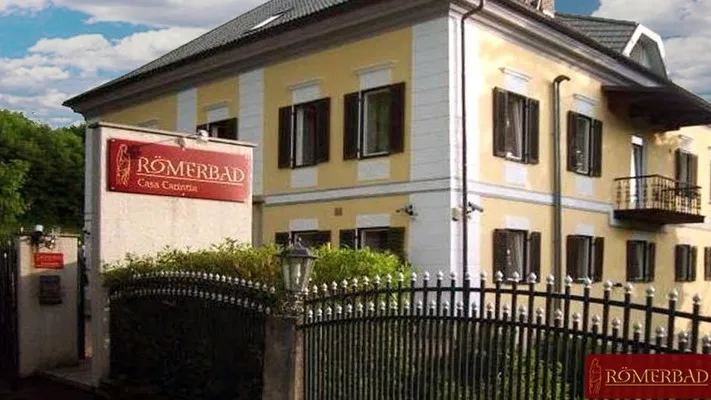
FKK Römerbad Casa Carintia Feldkirchen (A)
Unterrain 1, 9560 Feldkirchen
Last updated on
Something wrong or missing?
This club carries on under a new name.
Carries on as: Diablo Men's Club Feldkirchen (A)
Clubs nearby · FKK Römerbad Casa Carintia Feldkirchen (A)
Prices, opening times and all features · FKK Römerbad Casa Carintia Feldkirchen (A)
Features
Yes · 8
- Outdoor area (garden)
- Beer included
- Draught beer
- Card payment / ATM
- Finnish sauna
- Soft drinks included
- Solarium
- Indoor whirlpool
No · 22
- Air conditioning
- Cocktails
- Step-free access
- Food included
- Free parking
- Free Wi-Fi
- Live DJ
- Live shows
- Professional massage
- Pick-up service
- Adult cinema
- Overnight stay possible
- Valuables lockers
- Screened parking
- Slot machines
- SM room
- Live sport on TV
- Steam bath
- Indoor pool
- Outdoor pool
- Hot dinner
- Outdoor whirlpool
More features
Size / area
Small club
- Indoor
- 500 m²
- Outdoor
- 200 m²
What to expect at FKK Römerbad Casa Carintia Feldkirchen (A)
Feldkirchen
- Name origin
- Church in the field
- First documented mention
- 1065 AD
- Population
- 14,000
- Area
- 77.53 km²
- Federal state
- Carinthia
- District
- Feldkirchen
- Vehicle registration
- FE
- River
- Tiebel, Glan
The Club FKK Römerbad Casa Carintia is located in Feldkirchen-Unterrain.
Feldkirchen in Carinthia is the fifth-largest city in Carinthia. It lies northeast of Lake Ossiach in the Klagenfurt Basin, about 25 km northwest of Klagenfurt and 25 km northeast of Villach.
Feldkirchen itself sits at roughly 550 m above sea level. The municipal area ranges between 510 m (the lowest point, at the municipal border with Ossiach in the bed of the Tiebel) and 1,069 m (the highest point, Taubenbühel on the Ossiacher Tauern). The localities of the town municipality are organised into 12 cadastral communities; the town's municipal area comprises 86 localities.
Around 200 BC, the area was settled territory of the Celtic kingdom of Noricum. The Romans occupied Noricum in 15 BC and subsequently expanded the previously primitive road system. It is assumed that Roman Feldkirchen was the road station Beliandrum. Shortly before 600 AD, Slavic warrior nobility moved into the land and founded the principality of Carantania. Around the middle of the 8th century, a wave of Christianisation began in Carantania, originating from the Diocese of Salzburg and aimed at the "conversion" of the Slavs. Following the Benedictine monastery foundations of Ossiach (before 1027) and Millstatt (around 1070), extensive properties in Carinthia were granted to the church. The Diocese of Bamberg, only founded in 1007, was treated particularly generously in this regard and held great influence in the region for centuries. Today, the city of Bamberg maintains a town twinning partnership with both the city of Feldkirchen and the city of Villach.
In the late Middle Ages, Feldkirchen increasingly developed into a place striving for civic self-administration. In 1441, the Habsburg King Friedrich III put the citizens of Feldkirchen on an equal footing with those of the territorial markets and towns with regard to trade and commerce. The Bishop of Bamberg withdrew from Carinthia in 1675. After the revolutionary year of 1848, the Municipal Act of 17 March 1849 created the conditions for the formation of political local municipalities. Feldkirchen was thereby assigned to the district of Klagenfurt-Land. The present-day district of Feldkirchen has existed since 1 January 1982.
From Feldkirchen's long history, several notable buildings have survived, including the parish church Maria im Dorn from the 11th century, the branch church of St. Michael, the Bamberger Amthof, Schloss Dietrichstein, the ruined castle Prägrad, Schloss Lang and Schloss Poitschach.
Today, Feldkirchen is home mainly to smaller commercial businesses. Given its location in a traditional holiday region in the Alpine area, the town holds particular tourist appeal and is well suited, in both summer and winter, for holiday activities as part of a classic family holiday by the lake landscapes of Lake Ossiach and Lake Wörth, as well as for hiking, cycling tours and, of course, skiing holidays.