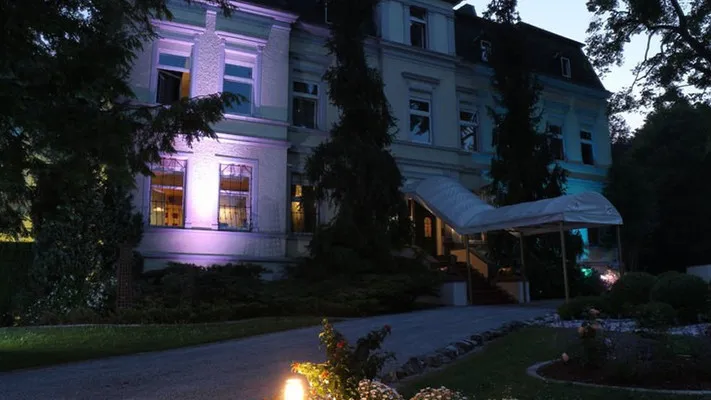
Parkschloss Marsberg (D)
(formerly Parkschloss Dali)
Madfelder Straße 2, 34431 Marsberg
Last updated on
Something wrong or missing?
Prices, opening times and all features · Parkschloss Marsberg (D)
Features
Yes · 11
- Outdoor area (garden)
- Beer included
- Cocktails
- Free parking
- Professional massage
- Overnight stay possible
- Finnish sauna
- Screened parking
- Soft drinks included
- Outdoor pool
- Indoor whirlpool
No · 19
- Air conditioning
- Draught beer
- Card payment / ATM
- Step-free access
- Food included
- Free Wi-Fi
- Live DJ
- Live shows
- Pick-up service
- Adult cinema
- Valuables lockers
- Slot machines
- SM room
- Live sport on TV
- Steam bath
- Indoor pool
- Solarium
- Hot dinner
- Outdoor whirlpool
More features
Family-run since 1992, about 4,000 m². Two Finnish saunas (wood-fired in the garden, one in the house), year-round heated outdoor pool, whirlpool, massages on request. Nightclub bar until 5 am with cocktails and champagne, restaurant (hot kitchen until 9 pm), 2,000 m² garden, suites. Own licensed hotel rooms. Large, free, video-monitored car park. 500 m from Bredelar station.
Size / area
Very large club
- Indoor
- 2300 m²
- Outdoor
- 10000 m²
What to expect at Parkschloss Marsberg (D)
Marsberg
- Name origin
- Eresburg (Frankish) --> Horohusun, Horhusen --> Mons Martis
- First documented mention
- 8th century AD
- Population
- 20,000
- Area
- 182.22 km²
- Federal state
- Nordrhein-Westfalen
- Administrative region
- Arnsberg
- District
- Hochsauerlandkreis
- Vehicle registration
- HSK
- River
- Diemel
The Saunaclub Das Parkschloss Dali is located in Marsberg-Bredelar.
Marsberg lies still within NRW at 240 m above sea level on the Briloner Höhen, charmingly embedded in the landscapes of the Teutoburger Wald / Eggegebirge nature parks to the north and the Diemelsee to the south, and only 3 km as the crow flies from the Hessian state border. Marsberg is a place steeped in history: In Obermarsberg, the Irminsul column on the Eresburg is said to have been the most important sanctuary of the Saxons. After its destruction by Charlemagne during the Saxon Wars, the Kloster Obermarsberg was built on this site, one of the oldest monasteries in Westphalia, which later passed to Kloster Corvey through Louis the Pious — a Benedictine abbey that developed in the 9th and 10th centuries into a powerful cultural, spiritual and economic centre in Saxon territory. From Kloster Obermarsberg, the surrounding area was Christianised; the Eresburg served at times as an imperial palatinate.
In the Middle Ages, Corvey lay within the sphere of power of the Bishop of Paderborn, with whom the abbey fell out. After the fall of Henry the Lion and the emergence of the Duchy of Westphalia belonging to the Electorate of Cologne after 1180, Marsberg, which belonged to Corvey, was largely surrounded by Cologne territories. Corvey itself placed itself under Cologne's protection in 1196. Around 1220, Obermarsberg became a town and received the right of self-governance from Corvey. The Archbishop of Cologne, Engelbert I, in his capacity as Duke of Westphalia, then subjugated the town in the immediately following years.
The histories of Niedermarsberg and Obermarsberg, as the upper town, did not always run in step. In 1808, during the period of Hessian rule, Niedermarsberg achieved complete separation from the upper town. Niedermarsberg was of particular importance to the town owing to its early industrial development. Mining, iron processing and copper production, and later also paper and glass production, were of central importance. Today, companies from the glass, metal, textile, plastics, paper and wood industries operate in Marsberg, and tourism also plays a major role as an economic factor. However, the town's largest employer is the LWL-Klinik Marsberg for psychiatry.
Sights in Marsberg are, of course, above all the Kloster Obermarsberg with the Stiftskirche St. Peter und Paul and the St. Nikolaikirche in the old town of Obermarsberg, the Historic Town Hall, the Bilsteinturm, the Kloster Bredelar and the Schloss Canstein.
Today, Marsberg is divided into the 17 town districts of Beringhausen, Borntosten, Bredelar, Canstein, Erlinghausen, Essentho, Giershagen, Heddinghausen, Helminghausen, Leitmar, Meerhof, Niedermarsberg, Obermarsberg, Oesdorf, Padberg, Udorf and Westheim. The friendly small town of Marsberg lies in beautiful NRW, south of Paderborn, amid richly varied and charming natural surroundings, inviting visitors to linger. The highest elevation in this town is the "Eisenberg", which lies east of the dam wall of the "Diemelsee" and whose highest peak reaches almost 600 m.
Around 20,000 people live in Marsberg. Anyone wanting to reach Marsberg quickly is best off taking the A44 motorway = Dortmund-Kassel, taking the Marsberg exit - "Meerhof" direction, then onto the B7 federal highway - from here it leads directly into the town centre. The B7 takes visitors along the town's most important traffic artery - the so-called east-west route, which runs through the entire Marsberg municipal area. Anyone searching for a suitable wellness hotel in this town in NRW will find attractive wellness and spa offers and can wonderfully recharge their energy there. Simply escape the hectic everyday life for a few days and let your soul dangle, far from all obligations. In Marsberg, everyone finds their perfect wellness hotel.
The actor Peter Lohmeyer, as well as Hans-Joachim Watzke, managing director of the Bundesliga football club Borussia Dortmund, come from Marsberg.