FKK Villa Arabella Bochum [RTC] (D)
Lohrheidestraße 63, 44866 Bochum-Wattenscheid
Last updated on
Something wrong or missing?
Prices, opening times and all features · FKK Villa Arabella Bochum [RTC] (D)
Features
Yes · 2
- Outdoor area (garden)
- Finnish sauna
No · 28
- Air conditioning
- Beer included
- Draught beer
- Card payment / ATM
- Cocktails
- Step-free access
- Food included
- Free parking
- Free Wi-Fi
- Live DJ
- Live shows
- Professional massage
- Pick-up service
- Adult cinema
- Overnight stay possible
- Valuables lockers
- Screened parking
- Slot machines
- SM room
- Soft drinks included
- Live sport on TV
- Steam bath
- Indoor pool
- Outdoor pool
- Solarium
- Hot dinner
- Indoor whirlpool
- Outdoor whirlpool
More features
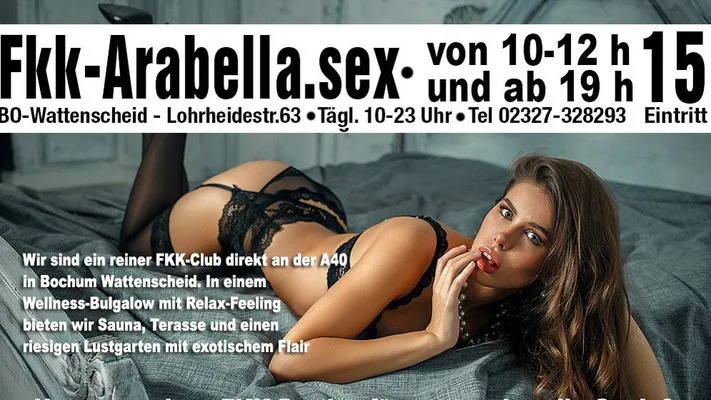
Pure FKK club right on the A40 in Bochum-Wattenscheid. Wellness bungalow with sauna, terrace and a large garden. 8 to 12 ladies every day.
Size / area
Small club
- Indoor
- 300 m²
- Outdoor
- 200 m²
What to expect at FKK Villa Arabella Bochum [RTC] (D)
Bochum-Wattenscheid
- Name origin
- boc-hem, boeken, bokum (alt. = Buchenhain)
- First documented mention
- 890 AD
- Population
- 365,000
- Area
- 145.66 km²
- Administrative region
- Arnsberg
- District
- /
- Vehicle registration
- BO, WAT
- River
- Ruhr
The club FKK Villa Arabella is located in Bochum-Wattenscheid.
"Bochum, ich komm' aus dir, Bochum, ich häng' an dir. Glück auf!", sings Herbert Grönemeyer. Which is a bit of a fib, since the popular singer is actually a native of Göttingen — but that hasn't stopped him from dedicating a hymn of love to his supposed hometown. Such heartfelt affection seems to be lost on Deutsche Bahn, though: unlike the other three Ruhr metropolises Duisburg, Essen and Dortmund, by no means all long-distance trains stop at Bochum Hauptbahnhof.
Anyone who nevertheless manages to get off in Bochum is treated to the Ruhr region in its purest form. A must-see is the Deutsches Bergbau-Museum on the northern edge of the city centre ring road. In the city you'll find a bustling shopping mile as well as the Bermuda-Dreieck, Bochum's famous entertainment and strolling quarter, where food stalls, pubs, bistros and cinemas line up one after another and, on fine summer evenings, half of Bochum seems to be out enjoying itself. The Bermuda-Dreieck stretches, on an imagined northern axis, all the way to the red-light district Im Winkel, known as the "Eierberg"; between these two spots, on Rottstraße, you could find Germany's last remaining peep show, the Miami Show-Center, until 2014.
There's plenty more to see in Bochum: opposite the Tierpark and Fossilium stands the theatre of Starlight Express, the longest-running musical at a single location in the world. Another theatre, the Bochumer Schauspielhaus, located a little south of the Bermuda-Dreieck, was shaped by Tana Schanzara, who came from a family of opera singers and was dubbed the "Ruhrpott-Duse" from the 1950s onward. She was born in Kiel and grew up in nearby Dortmund after her parents took up an engagement at the opera house there. With her song "Vatter, aufstehen!!" she gave German radio listeners of the time a vivid picture of what "marital bliss" looked like in the Ruhrpott. Tana Schanzara stayed loyal to the Bochum theatre for more than 50 years. In her honour, the square in front of the Schauspielhaus was renamed "Tana-Schanzara-Platz" and a monument to her was erected there.
An absolute highlight is also the Planetarium, not to be confused with the equally worthwhile Bochumer Sternwarte. Anyone determined to have some fun and with enough spare cash can also start a shopping tour at Ruhr-Park, one of the largest shopping centres in Germany, right on the A40 between Bochum and Dortmund.
Alongside Essen-Duisburg and Dortmund, Bochum is one of the university towns along the A40 route straight through the Ruhr region. The university lies in the south of the city, in the Querenburg district. It's also worth it for non-academics to venture in that direction as far as Burg Blankenstein and the Kemnader See. Here, far from the noise of the city centre, you inevitably discover a different, quiet, nature-close Bochum, one that slopes down into the Ruhr valley amid gentle, lush green hills, inviting you to wander and daydream.
Well-known sons and daughters of Bochum include Peter Scholl-Latour, Otto Schily, Manfred Eigen, Hans Korte, Norbert Lammert, Ingo Naujoks, Thomas Hermanns, Kathy Krause, Britta Steilmann and Bastian Pastewka.