Salome Herne (D)
Riemker Straße 110, 44625 Herne
Last updated on
Something wrong or missing?
Prices, opening times and all features · Salome Herne (D)
Features
Yes · 4
- Outdoor area (garden)
- Finnish sauna
- Soft drinks included
- Outdoor pool
No · 26
- Air conditioning
- Beer included
- Draught beer
- Card payment / ATM
- Cocktails
- Step-free access
- Food included
- Free parking
- Free Wi-Fi
- Live DJ
- Live shows
- Professional massage
- Pick-up service
- Adult cinema
- Overnight stay possible
- Valuables lockers
- Screened parking
- Slot machines
- SM room
- Live sport on TV
- Steam bath
- Indoor pool
- Solarium
- Hot dinner
- Indoor whirlpool
- Outdoor whirlpool
More features
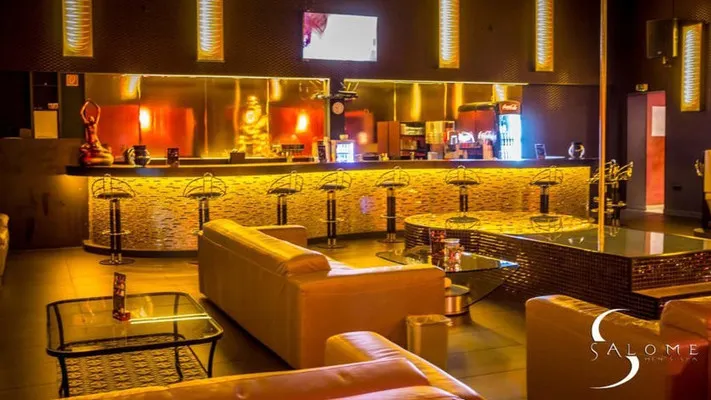
A well-known Ruhr area club for decades, on the border to Bochum, large and modernly furnished. Large sauna, terrace with a small pool, several lounges with a bar, themed rooms. Parking in front of the house.
Size / area
Large club
- Indoor
- 2000 m²
- Outdoor
- 500 m²
What to expect at Salome Herne (D)
Herne
- Name origin
- uilla Haranni in pago Borahtron (lat./germ., villa Haranni) --> Herne
- First documented mention
- 880 AD
- Population
- 157,000
- Area
- 51.42 km²
- Federal state
- Nordrhein-Westfalen
- Administrative region
- Arnsberg
- District
- /
- Vehicle registration
- HER, WAN
- River
- Emscher
The Club Salome is located in Herne-Süd.
If there is one city that still comes closest to the long since unrealistic clichés of the Ruhrpott milieu, then it's Herne. The geographical centre of the Ruhr area lies in Herne, a fair bit north of the Ruhr, right where the coal mines held out the longest. Here the man on the street still speaks with the pure sound of the working-class tongue, and if he happens to come from Wanne-Eickel, he usually complains with unadulterated bluntness that Wanne-Eickel has been leading a stepmotherly existence ever since it was incorporated into the city of Herne on 01.01.1975, even though it's supposedly the more important town in every respect and even has the bigger railway station.
Herne has existed for more than a thousand years, but until the middle of the 19th century the town was just a small village. In 1847 the railway connection was built, and after that the village of Herne began its rise to become an industrial town. Herne only received town charter status in 1897, though. Today the city consists of the four districts of Wanne, Eickel, Herne-Mitte and Sodingen.
On 21.12.2018, it was "Schicht im Schacht" (shift's over) at the last German coal mine, Zeche Prosper-Haniel in Bottrop. It was the last of hundreds of closed mines that had been in operation in the Ruhr area, especially since the 19th century. There were a few of these in Herne/Wanne-Eickel too, they were called Zeche Shamrock, Constantin, Mont Cenis, Friedrich der Große, Königsgrube or Teutoburgia, and they too ceased operations long ago. The city was hit hard by this, but the mining past lives on in the townscape through several preserved pit head towers. Numerous mining support associations keep the tradition alive to this day.
Glück auf, life goes on - among those based in Herne today are the concrete pump manufacturer Schwing, the VULKAN-Gruppe, Evonik-Degussa, Sasol, UPS, the pharmaceutical wholesaler Phönix, Sanacorp, Deutsche Annington and the well-known bus tour operator Anton Graf. The RAG Deutsche Steinkohle AG, responsible for Ruhr coal mining, is also headquartered in Herne.
It's not the Ruhr that flows through Herne, but the Emscher, as well as the federal waterway Rhein-Herne-Kanal, on which the city operates several harbours including the Yachthafen Herne-Ost.
What's going on in Herne?
- Worth a visit is the city's landmark, the Wasserschloss Strünkede in Baukau.
- The music festival Tage Alter Musik in Herne, held annually since 1976, now ranks among the most significant festivals for early music worldwide.
- Der Mond um Wanne-Eickel: since 2002, the well-known music festival Wanner Mondnächte has taken place every year around Fronleichnam, over three consecutive days, in Wanne around the Buschmannshof.
- Starting on the first Friday in August, the Cranger Kirmes (Crange is a district of Wanne-Eickel) is held every year for a period of ten days, and it ranks among the largest folk festivals in Germany after the Munich Oktoberfest.
Herne is the hometown of the late musician and big band leader Kurt Edelhagen, the schlager singer Jürgen Marcus, the actor Joachim Król, as well as the sports journalist, TV presenter and former figure skater Rudi Cerne.