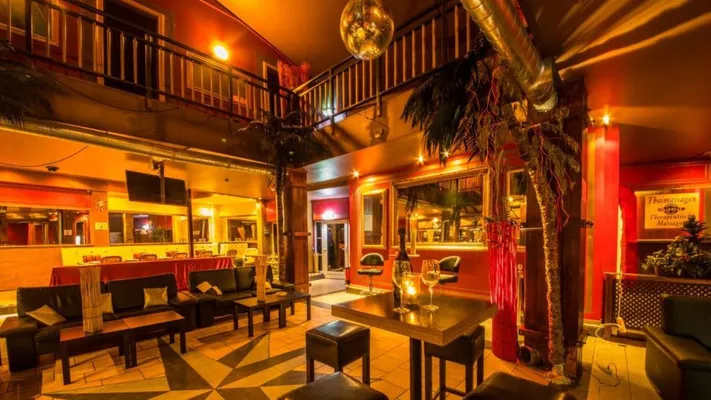
22 (ex Lekkerding) Emmerich (D)
Tackenweide 22, 46466 Emmerich
Last updated on
Something wrong or missing?
This club has closed for good.
Clubs nearby · 22 (ex Lekkerding) Emmerich (D)
Prices, opening times and all features · 22 (ex Lekkerding) Emmerich (D)
Features
Yes · 15
- Outdoor area (garden)
- Draught beer
- Card payment / ATM
- Food included
- Free parking
- Adult cinema
- Finnish sauna
- Screened parking
- Slot machines
- SM room
- Soft drinks included
- Live sport on TV
- Hot dinner
- Indoor whirlpool
- Outdoor whirlpool
No · 15
- Air conditioning
- Beer included
- Cocktails
- Step-free access
- Free Wi-Fi
- Live DJ
- Live shows
- Professional massage
- Pick-up service
- Overnight stay possible
- Valuables lockers
- Steam bath
- Indoor pool
- Outdoor pool
- Solarium
More features
Size / area
Medium-sized club
- Indoor
- 800 m²
- Outdoor
- 300 m²
What to expect at 22 (ex Lekkerding) Emmerich (D)
Emmerich
- Name origin
- villa Embrici (Lat., = house of Embrich/Embrico)
- First documented mention
- 828 AD
- Population
- 31,000
- Area
- 80.40 km²
- Federal state
- Nordrhein-Westfalen
- Administrative region
- Düsseldorf
- District
- Kleve
- Vehicle registration
- KLE, GEL
- River
- Rhein
The Club Lekkerland is located northeast of Emmerich's town centre, in the district of Leegmeer.
Emmerich is an old Hanseatic town with an exposed location on the Rhein. The town lies on the Lower Rhine floodplain and borders directly onto the Netherlands to the north and west; the southern town boundaries are marked by the course of the Rhein. Emmerich is thus the northernmost German town on the Rhein. The town centre lies at an altitude of 17 metres above sea level; nevertheless, with the excursion area of the Eltener Höhen (which belonged to the Netherlands from 1949 to 1963), the town has a natural range of hills rising up to 82 metres above sea level. On top of the Eltenberg stands the roughly 1,000-year-old St. Vitus Stiftskirche, one of the oldest churches on the Lower Rhine altogether. Its immediate location on the Rhein also gives the town an extensive natural landscape shaped by the historical shifts of the great river's course, with dunes, island formations and silted-up areas, as can be seen for instance in the Emmericher Ward nature reserve. Fittingly, the town's two modern landmarks — the 1.5-kilometre-long Rheinpromenade on one hand, and Germany's longest suspension bridge spanning the Rhein, the "Golden Gate Bridge of the Lower Rhine", on the other — are found right against this backdrop. Furthermore, you'll also find about half a dozen ship landing stages here, including a pretty marina.
Emmerich was founded as early as around 700 AD as a mission station with its own church in the Bishopric of Utrecht by the canonised Anglo-Saxon missionary Willibrord (658-739). In 1040 the Stiftskirche St. Martini was built; today, after many architectural changes over the centuries, it stands as the second-oldest sacred building in Emmerich, a listed church right on the Rheinuferpromenade. In 1233 Emmerich was granted town status and from then on experienced an economic heyday, which reached its full bloom through its membership of the Hanseatic League between 1307 and 1570. With the turmoil of war over the following roughly 200 years — in particular the Eighty Years' War (1568–1648) between the Netherlands and Spain, the Thirty Years' War (1618-1648) and the Seven Years' War (1756-1763), right through to the upheavals of the Napoleonic occupation — the town had to endure impoverishment and decline. The once picturesque medieval town centre was almost completely destroyed in World War II; today you can still find a few pretty ensembles in the tranquil lanes around Alter Markt, Steinstraße and Geistmarkt. A lovely excursion destination in the town is the 18th-century manor house Schlößchen Borghees, today used as a cultural centre.
Modern Emmerich is a thoroughly liveable and thriving town with idyllic excursion destinations and a healthy portfolio of medium-sized industrial and service companies. The former garrison town benefits, both economically and touristically, from its location on the border with the Netherlands. The entrepreneurial dynasty Gimborn, today a major manufacturer of pet products, is particularly formative for the town. The well-known confectionery manufacturer "Katjes" also calls Emmerich home.
Contrary to claims to the contrary, German football legend Lothar Emmerich does not actually come from Emmerich (but from Dortmund) — though the equally famous German-Dutch footballer and 1974 World Cup winner Rainer Bonhoff does.