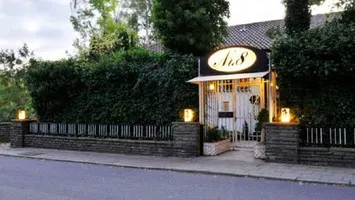
Penelope Essen (D)
Hundebrinkstraße 8, 45326 Essen
Last updated on
Something wrong or missing?
This club carries on under a new name.
Carries on as: Penelope de Luxe Castrop-Rauxel (D)
Prices, opening times and all features · Penelope Essen (D)
Features
Yes · 7
- Cocktails
- Food included
- Professional massage
- Valuables lockers
- Finnish sauna
- Soft drinks included
- Live sport on TV
No · 23
- Air conditioning
- Outdoor area (garden)
- Beer included
- Draught beer
- Card payment / ATM
- Step-free access
- Free parking
- Free Wi-Fi
- Live DJ
- Live shows
- Pick-up service
- Adult cinema
- Overnight stay possible
- Screened parking
- Slot machines
- SM room
- Steam bath
- Indoor pool
- Outdoor pool
- Solarium
- Hot dinner
- Indoor whirlpool
- Outdoor whirlpool
More features
Size / area
Very small club
- Indoor
- 300 m²
What to expect at Penelope Essen (D)
Essen
- Name origin
- astnide (Germanic = place in the east) --> Essen
- First documented mention
- 898 AD
- Population
- 583,000
- Area
- 210.34 km²
- Federal state
- Nordrhein-Westfalen
- Administrative region
- Düsseldorf
- District
- /
- Vehicle registration
- E
- River
- Ruhr, Emscher
The Club Penelope is located in Essen-Altenessen-Süd.
The name of the city of Essen is inseparably linked to the industrial dynasty Krupp, which already held high offices in the city back in the 16th century. In 1811 Friedrich Krupp founded the Krupp-Gussstahlfabrik here; in the course of industrialisation the city experienced a gigantic boom. As late as the 1960s the city counted over 700,000 inhabitants, it became a bishop's seat, and the Kettwiger Straße was one of the busiest shopping streets in Germany, still attracting numerous tourists today, although the mega shopping centres Rhein-Ruhr-Centrum, Ruhr-Park and Centro, built since the 1970s, have long since outranked it. Due to a marked decline in population, Essen has since had to cede its status as the most populous metropolis of the Ruhr area to Dortmund, whose city area is in any case considerably larger.
At the northwestern end of Kettwiger Straße stood the headquarters of the Essen department store chain Karstadt; this building has now given way to the recently completed shopping gallery at Limbecker Platz, huge by inner-city standards. Diagonally opposite lies the Berliner Platz, behind which stretches the well-known red-light district on Stahlstraße. With the Colosseum, conceived as a musical theatre and also found here, and the inner-city Grillo-Theater, named after the Essen industrialist Friedrich Grillo, the city boasts two notable theatre stages.
The Zeche Zollverein with the Ruhrmuseum - a UNESCO World Heritage Site since 2001 and a highlight on the tourist route of industrial culture - is regarded as the city's landmark, even though the mining industry has long since lost its outstanding significance for the city. Essen is today home to numerous major corporations such as RWE, E.ON, ThyssenKrupp, Brenntag, Evonik (Goldschmidt), Innogy, Hochtief, Steag, Aldi-Nord, BackWerk, Karstadt, Deichmann, Medion, Schenker, Ferrostaal and Funke Mediengruppe.
With the Villa Hügel, built by Alfred Krupp between 1870-1873, which today is owned by the Alfried Krupp von Bohlen und Halbach-Stiftung and is part of the city's obligatory tourist programme, the Krupp dynasty built itself a monumental residence on the northern edge of the Baldeney-See in the south of Essen, whose aesthetics one may argue about. What cannot be disputed, however, is the builder's skill in choosing the location, for the estate sits majestically on the northern edge of the enchanting Ruhrtal landscape. Starting from the Grugapark located in Essen's southern district and extending to the wooded hills beyond the lake between Kettwig, Werden and Kuferdreh, one finds here a unique leisure paradise, whose graceful beauty inevitably makes the amazed observer feel transported to the gently rustling shores of Lake Garda.
Well-known sons and daughters of Essen include Karl Baedeker, Alfred Krupp, Friedrich Krupp, Friedrich Alfred Krupp, Bertha Krupp von Bohlen und Halbach, Alfried Krupp von Bohlen und Halbach, Friedrich Grillo, Heinz Rühmann, Karl & Theo Albrecht, Alfred Herrhausen, Hildegard Hamm-Brücher, Hans Stern, Ruth Leuwerik, Heinz-Horst Deichmann, Uta Ranke-Heinemann, Elisabeth Volkmann, Helmut Rahn, Otto Rehhagel, Manfred Burgsmüller, Jens Lehmann, Marie-Louise Marjan, Ralf Richter, Diether Krebs, Juliane Werding and Ingo Appelt.