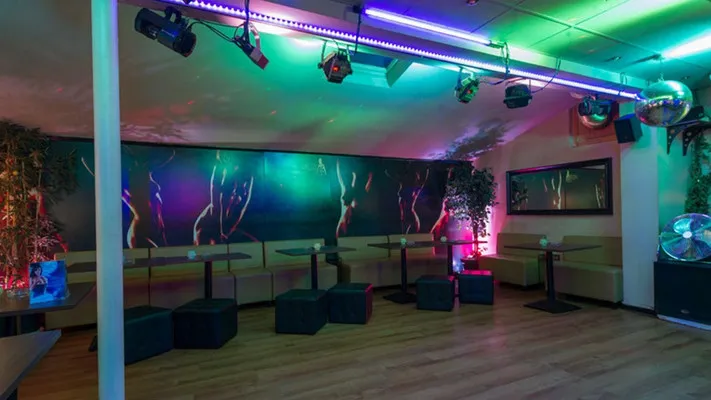
FKK Night & Day Bürstadt (D)
Die Ammenwiese 13, 68642 Bürstadt
Laatst bijgewerkt op
Klopt er iets niet of ontbreekt er iets?
Deze club is definitief gesloten.
Clubs in de buurt van FKK Night & Day Bürstadt (D)
Kenmerken
Ja · 16
- Air conditioning
- Outdoor area (garden)
- Beer included
- Card payment / ATM
- Food included
- Free parking
- Live shows
- Professional massage
- Adult cinema
- Valuables lockers
- Finnish sauna
- Screened parking
- Slot machines
- Soft drinks included
- Solarium
- Outdoor whirlpool
Nee · 14
- Draught beer
- Cocktails
- Step-free access
- Free Wi-Fi
- Live DJ
- Pick-up service
- Overnight stay possible
- SM room
- Live sport on TV
- Steam bath
- Indoor pool
- Outdoor pool
- Hot dinner
- Indoor whirlpool
Meer kenmerken
Grootte / oppervlakte
Kleine club
- Binnen
- 400 m²
- Buiten
- 100 m²
Wat je bij FKK Night & Day Bürstadt (D) kunt verwachten
Bürstadt
- Name origin
- Bisistat --> Birstat (Franconian, = seat of the Frankish prince Biso)
- First documented mention
- 767 AD "in Birstather marca" (wording of a deed of donation)
- Population
- 16,000
- Area
- 34.46 km²
- Federal state
- Hessen
- Administrative region
- Darmstadt
- District
- Bergstraße
- Vehicle registration
- HP
- River
- Rhein (beyond the town limits)
The club FKK Night & Day is located in Bürstadt, northeast of the town centre.
Bürstadt lies in the Upper Rhine Plain between the Rhein and the Odenwald in the Hessisches Ried. Not far from the town, the tourist route of the Bergstraße runs to the east, and to the west runs the Rhein, which here forms the state border between Hessen and Rheinland-Pfalz. On the opposite bank of the Rhein lies the town of Worms.
About 10 km east of Bürstadt lies the town of Lorsch. It is known for Kloster Lorsch, a World Heritage Site, which was founded in 764 by Count Cancor. Bürstadt was first mentioned in a document as early as 767, in a deed of donation from the Lorsch Codex, an inventory of the monastery's possessions. In 1232 Emperor Friedrich II placed the imperial abbey of Lorsch under the Archbishopric of Mainz, which triggered centuries of disputes between Kurmainz and the Palatine counts of the Kurpfalz as holders of the bailiwick rights. In the age of the Reformation, the Kurpfalz dissolved Kloster Lorsch in 1564; in 1782 Kurmainz made Lorsch a superior bailiwick office. As a consequence of the Napoleonic Wars, Kurmainz was dissolved in 1803, and Bürstadt came under the Landgraviate of Hessen-Darmstadt, which adopted the constitution of the Grand Duchy of Hessen in 1820 and joined the German Empire in 1871.
With the connection of the Nibelungen railway line from Worms via Lorsch to Bensheim, the village-like Bürstadt entered the industrial age. The Bürstadt railway station is one of the few tower stations in Germany. After the Second World War, Bürstadt changed from a purely agricultural community into a small town with a not insignificant amount of industry.
Bürstadt, including the two districts of Bobstadt and Riedrode, now has over 16,000 inhabitants and benefits from its favourable location at two transport hubs. On the one hand, Bürstadt lies at the intersection of the ICE line Mannheim-Frankfurt and the Nibelungenbahn Worms-Bensheim; on the other hand, the important federal roads B44, running north-south between Mannheim and Frankfurt, and the B47, running east-west between Worms and Bensheim, cross at the edge of the town. Within a radius of less than 10 km there are connections to four motorways.
Bürstadt lies in one of the most historically rich cultural landscapes in Germany. It is not least the setting for the mysterious Nibelungen saga.
The gymnastics youth of the world has been meeting regularly in Bürstadt since 1954 for the Gymnastica, a kind of international gymnastics sports festival that, besides competition, above all promotes intercultural exchange. The mostly young athletes perform sports acrobatics at the highest level.