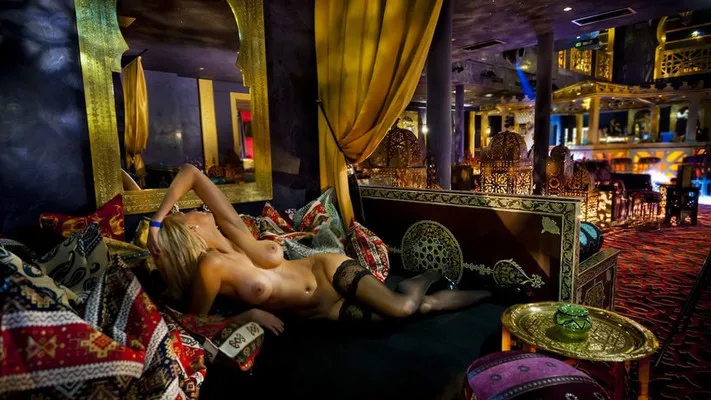
FKK Paradise Graz (A)
Am Engelsdorfgrund 4, 8041 Graz-Liebenau
Last updated on
Something wrong or missing?
Prices, opening times and all features · FKK Paradise Graz (A)
Features
Yes · 11
- Outdoor area (garden)
- Food included
- Professional massage
- Adult cinema
- Finnish sauna
- Soft drinks included
- Steam bath
- Outdoor pool
- Hot dinner
- Indoor whirlpool
- Outdoor whirlpool
No · 19
- Air conditioning
- Beer included
- Draught beer
- Card payment / ATM
- Cocktails
- Step-free access
- Free parking
- Free Wi-Fi
- Live DJ
- Live shows
- Pick-up service
- Overnight stay possible
- Valuables lockers
- Screened parking
- Slot machines
- SM room
- Live sport on TV
- Indoor pool
- Solarium
More features
Open since the end of 2012, about 2,500 m², 20 rooms. Finnish sauna, steam bath, whirlpool, outdoor whirlpool, pool on the terrace, massages. Bar, restaurant, buffet, erotic cinema, table dance, VIP area, smoking lounge. Escort possible. Brothel (Laufhaus) in the same building.
Size / area
Large club
- Indoor
- 2300 m²
- Outdoor
- 200 m²
What to expect at FKK Paradise Graz (A)
Graz-Liebenau
Graz
Provincial capital of the federal state of Styria
Name origin: gradec (Slav./Slovenian;= small castle, fortified place) --> Gratz, Grätz
First documented mention: 1140 AD
Population: 291,000
Area: 127,57 km²
Federal state: Styria
District: Statutory City
Vehicle registration: G
River: Mur
The Club FKK Paradise is located in Graz's 7th district, Liebenau.
Graz is Austria's second-largest city after Vienna, a former Habsburg residence city, a city of culture and reformation as well as a university city.
It lies in the Graz Basin on both sides of the Mur and was already a densely settled agricultural landscape in Roman times. In the 6th century Slavs built a castle here, from which the city's name derives. By around 1230 Graz had developed into a fully-fledged town with a market, jurisdiction and fortifications; in 1379 it became the residence of the Habsburgs, who governed what was then Inner Austria from Graz Castle, until the Turks reached the Graz area during their campaigns in 1619 and the entire court moved to the Vienna Hofburg. During the age of the Reformation, the majority of the population converted to Protestantism, and the city experienced a new cultural flourishing during this time. The university was founded in 1585, making it the second-oldest in Austria. With the age of industrialisation, Graz became home to numerous significant commercial and industrial enterprises.
Like Vienna, Graz is a sheer splendour, though in a somewhat different way, for at the geographical centre of the city stands the Schloßberg, which served as a fortress between 1125 and 1809. The historic old town of Graz and its roofscape were declared a UNESCO World Heritage Site due to their excellent state of preservation, and the city holds an endless list of sights. These include: the Schloßberg itself, Schloss Eggenberg, the Grazer Dom, the Uhrturm, the Paulustor, the Palmburg, the Palais Saurau, the Palais Kellersberg, the Witwenpalais, the Palais Attems, the Admonterhof, the Reinerhof, the Dreifaltigkeitskirche, the Grazer Burg, the Mausoleum, the Domherrenhof, the Burgtor, the Rathaus, the Landeszeughaus, the Schauspielhaus, the Bischöfliche Palais, the Opernhaus, the Messe-Schlössl and many more.
Among the well-known people born in Graz are the two emperors Ferdinand II and Ferdinand III, Johann Bernard Fischer von Erlach, Joseph von Hammer-Burgstall, Archduke Franz Ferdinand, Roman von Ungern-Sternberg, Gerhard Roth, Robert Stolz, Karl Böhm, Rudolf Lenz, Werner Schneyder, Heinz Fischer and Andreas Gabalier.